










VHS vs DVD Explained: Quality, Durability, and the Real Reason People Still Care
 Donna Peng
Updated on
VHS and DVD are often compared as two milestones in home entertainment, but they represent very different ways of storing and experiencing movies. VHS relies on analog magnetic tape, which gradually wears out over time, while DVD uses digital data that delivers clearer image quality and more stable playback.
For many users today, the real question is not just which looks better, but which format is more practical for preservation, collection, or digital conversion. This difference becomes especially important when old home recordings, movie collections, or rental-era tapes start to degrade, making long-term media backup a growing concern for collectors and everyday users alike.
Quick Answer: VHS or DVD — Which One Is Better?
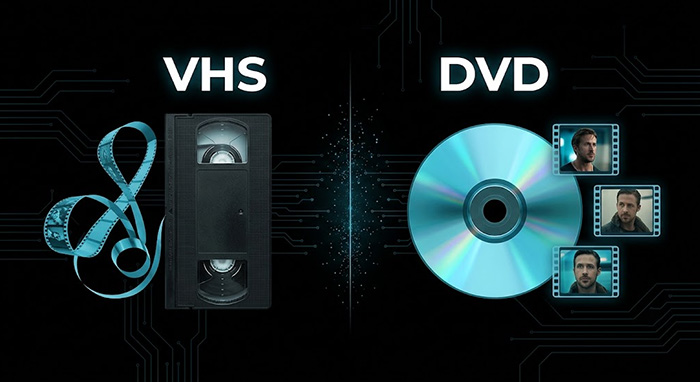
When choosing between VHS and DVD, the "better" option depends entirely on what you value more: modern playback convenience or vintage analog charm. If your goal is crisp visuals, durable archiving, and seamless compatibility with modern screens, DVD is the clear winner. However, if you are a collector craving nostalgic warmth, tracking artifacts, and physical media history, VHS offers an irreplaceable experience that digital formats cannot replicate.
To help you decide based on your specific needs, here is a quick breakdown of how these two iconic formats stack up against each other:
| If Your Main Goal Is... | Better Choice | The Core Reason |
|---|---|---|
| Maximum Picture Crispness | DVD | Provides clear digital resolution (~480p) free of screen jitter or tape fuzz. |
| Authentic 80s/90s Nostalgia | VHS | Delivers that classic analog warmth, unique tracking lines, and retro physical aesthetic. |
| Long-Term Shelf Life | DVD | Resists environmental decay, whereas magnetic tape naturally degrades after 10–20 years. |
| Rare/Unreleased Content | VHS | Thousands of obscure indie films and home recordings were never ported to digital formats. |
| Quick Digital Backup | DVD | Laser-read data can be ripped in minutes, while VHS requires real-time, frame-by-frame recording. |
The fundamental divide comes down to how data is stored. Think of a VHS tape like a long strip of paper where a machine draws images using magnetic dust; every time you play it, the drawing rubs off just a tiny bit. A DVD, on the other hand, acts like a microscopic mirror. A laser beam reads tiny pits stamped into the plastic without ever physically touching the data layer, ensuring the thousandth playback looks exactly like the first.
While streaming and Blu-ray have pushed home video into the high-definition era, the debate between VHS and DVD remains highly relevant for archivers looking to digitize family memories and cinephiles building unique physical media libraries.
Read More: What Resolution Is Blu-ray? DVD vs Standard Blu-ray vs 4K Blu-ray Explained
What VHS Actually Was (And Why It Dominated the 1980s–90s)
To understand the magic of VHS, you have to look beneath its chunky plastic shell. VHS, which stands for Video Home System, is an analog format introduced by JVC in the late 1970s. Inside every cassette sits a long, delicate ribbon of plastic coated with microscopic magnetic particles. When you pop the tape into a VCR (Video Cassette Recorder), the machine pulls this ribbon out and wraps it around a rapidly spinning metal drum. This drum reads the magnetic patterns on the tape and instantly converts them into video and audio signals for your television.
This physical mechanism is exactly why VHS tapes develop unique visual traits over time. If you have ever noticed fuzzy static or horizontal distortion on an old tape, you are experiencing tracking lines. Tracking refers to how perfectly the VCR's internal heads align with the recorded tracks on the magnetic tape. Because tape stretches, warps, and collects dust every time it is played, users frequently had to press manual "tracking buttons" on their remotes to realign the machine's read-head with the shifting physical tape path. This organic, imperfect nature is precisely what fuels today's retro analog aesthetic.
Despite its mechanical vulnerabilities, VHS completely dominated global home entertainment for two full decades. Its massive success boiled down to a few revolutionary breakthroughs:
- The Power to Record Live TV: Unlike its early rival, Sony’s Betamax, or the unrecordable LaserDisc, VHS let everyday users record broadcast television. For the first time in history, you didn't have to miss your favorite sitcom because you were stuck at work or out for dinner; you could simply "tape it."
- Unmatched Playback Length: A standard T-120 VHS tape could easily hold two hours of footage in standard mode—and up to six hours in lower quality modes. This was long enough to capture a full Hollywood blockbuster or an entire Sunday afternoon football game without swapping media.
- The Birth of Rental Culture: Because VHS tapes were relatively affordable for businesses to buy in bulk, they triggered the global explosion of the neighborhood video rental store. Brands like Blockbuster turned movie nights into a tactile, social ritual of browsing physical shelves, reading back-covers, and racing to return tapes on time to avoid late fees.
Ultimately, VHS did not just change how we watched movies—it handed control over to the viewer. It transformed television from a fleeting, live medium into a personalized, collectible archive, cementing its place as the undisputed king of 20th-century pop culture.
Read More: DVD-R vs DVD+R: Movies, Data, Compatibility & More
What Made DVD Feel Revolutionary in the Late 1990s
When the Digital Versatile Disc (DVD) hit the market in the late 1990s, it didn’t just feel like a minor upgrade—it felt like stepping into the future. Overnight, home video transitioned from a temperamental mechanical system to a sleek, laser-read digital format. DVD didn’t just improve quality — it changed how people interacted with movies. It turned passive viewing into an interactive, premium experience that made the old plastic cassette look like a relic from the stone age.
At the heart of this revolution was a massive leap in raw visual horsepower: a crystallinely clear 480p resolution. While that number sounds modest today, it was an astronomical jump from the fuzzy, soft output of analog tape. Suddenly, background details became sharp, text on screen was legible, and colors popped with a vibrant accuracy that matched the local movie theater.
However, the real magic of DVD lay in its digital architecture, which introduced features that completely altered consumer habits:
- The End of Rewinding: Because a DVD player uses a non-contact optical laser rather than physical rollers, it can jump to any part of the disc instantly. Movie lovers said a joyful goodbye to the tedious, noisy ritual of "Be Kind, Please Rewind" before returning a film.
- Instant Chapter Menus: DVDs sliced movies into digital fragments. If you wanted to skip directly to an iconic action sequence or a favorite musical number, you no longer had to hold down the fast-forward button while guessing the timing; you simply clicked a button on the interactive on-screen menu.
- True Widescreen (Letterbox) Format: For decades, VHS forced movies into a square box using "pan-and-scan" cropping, cutting off up to 40% of the original theatrical picture. DVD popularized the 16:9 widescreen format, allowing film buffs to view cinematic masterpieces exactly as the director intended.
- The Explosion of Special Features: Thanks to the massive storage capacity of a digital disc, studios could bundle "bonus content" alongside the film. Audio commentaries, deleted scenes, behind-the-scenes documentaries, and interactive games turned a simple movie purchase into a deep, collectible archive.
To put the physical difference into perspective, imagine trying to find a specific word in an ancient scroll versus a modern printed book. With a scroll (like a VHS tape), you have to unroll the entire thing line by line to get to the middle. With a book (like a DVD), you can flip straight to page 120 in less than a second. This seamless, instant access is exactly what crowned DVD as the fastest-adopted consumer electronics format in history.
VHS vs DVD: The Real Differences That Users Still Notice Today
Decades after their respective peaks, the mechanical chasm between analog tape and digital disc remains highly visible. Whether you are sorting through boxes in your attic, hunting for retro media, or planning a digitization project, these five core differences dictate how these formats look, sound, and survive today.
Video Quality: Soft Analog vs. Sharp Digital
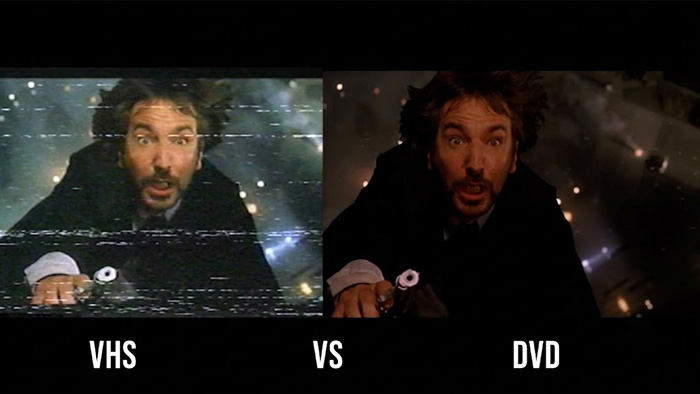
The visual gap between VHS and DVD is immediately noticeable on any screen, but it becomes glaringly obvious on modern high-definition displays. VHS resolution tops out at roughly 240 unique vertical lines (the analog equivalent of about 320 × 240 pixels). Because it is an analog signal, it is prone to constant analog noise—that subtle, grain-like fuzz, color bleeding, and edge distortion that softens the image.
DVD completely changes the game by using a digital raster of 720 × 480 pixels. Because it bypasses the physical fluctuations of a magnetic tape reader, it delivers a vastly sharper image with precise color separation, deep contrast, and zero screen jitter. If you watch a movie on VHS, a dark scene might dissolve into a murky puddle of gray artifacting; on DVD, that same scene maintains its geometric clarity and shadow detail.
Audio Quality: Warm Hi-Fi vs. Multi-Channel Dolby Digital
While video quality gets the most attention, the acoustic difference is just as profound. Late-generation VHS tapes featured "VHS Hi-Fi," an analog stereo technology that offered surprisingly deep, warm bass and excellent dynamic range. However, it was still fundamentally limited to two channels (Left and Right).
DVD brought true movie-theater acoustics into the living room by introducing compressed, multi-channel digital audio formats like Dolby Digital and DTS 5.1 surround sound. Instead of mixing all sound effects, music, and dialogue into two tracks, DVD splits the audio across five independent directional speakers and a dedicated subwoofer. On a DVD, a spaceship flying overhead actually sounds like it is traveling from behind your couch to the front of your room.
Durability: The Silent Killers of Physical Media
If you are holding onto old media, physical degradation is your biggest enemy. Both formats face unique structural vulnerabilities over time:
- VHS Tape Degradation & Mold: Magnetic tape is highly sensitive to the environment. Changes in humidity cause the tape layers to stick together, attracting white, fuzzy VHS mold that can permanently eat away the magnetic coating. Furthermore, the magnetic charge itself naturally fades over 10 to 20 years, causing your home videos to slowly lose color, brightness, and contrast even if they just sit on a shelf.
- DVD Disc Rot & Scratches: DVDs are immune to magnetic fade and mold, but they aren't immortal. Severe surface scratches can block the playback laser, causing the movie to freeze or skip. Worse yet is disc rot—a rare chemical breakdown where the internal reflective aluminum layer oxidizes due to poor manufacturing glue, rendering the data unreadable from the inside out.
Convenience: The Friction of Friction-Based Media
The daily user experience of these two formats could not be more different. VHS is built entirely on mechanical friction. To watch a specific scene, you have to physically wind hundreds of feet of tape back and forth, a process that strains the VCR motor and wears down the media. Additionally, the bulky plastic shells take up significant real estate on living room shelves.
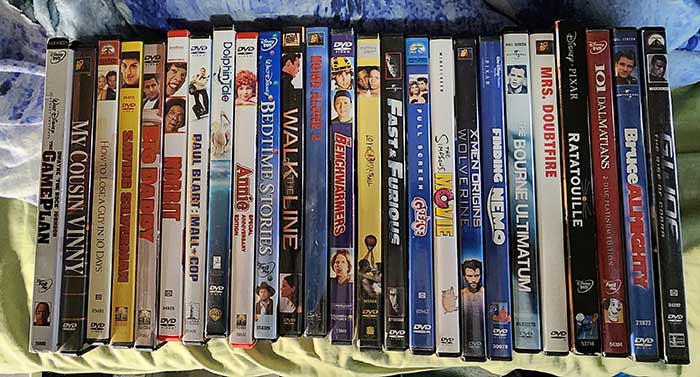
DVD stripped away all physical friction. Its ultra-slim plastic cases occupy less than half the storage size of a VHS tape, allowing collectors to store twice as many movies in the same space. Combined with interactive menus that grant instant scene access, DVD turned watching a movie into a completely frictionless, on-demand experience.
Collecting Experience: Tactile Nostalgia and the CRT Factor
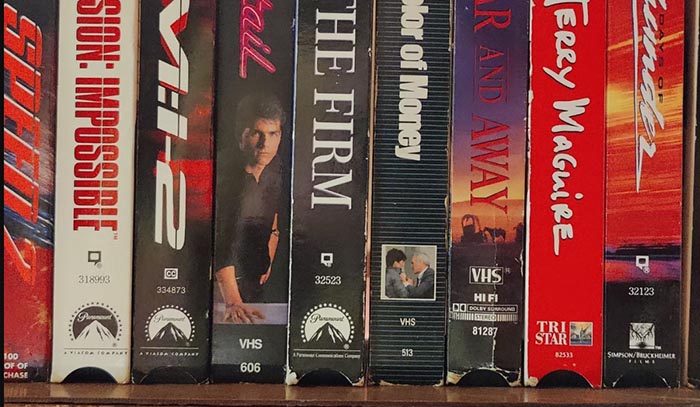
Despite DVD winning on technical specs, VHS dominates the emotional landscape for retro enthusiasts. There is an undeniable magic to the big, colorful VHS box art—especially the oversized, squishy "clamshell" cases used by Disney or the gritty, textured cardboard slipcovers of 80s horror movies.
For purists, a VHS tape played on a modern 4K flat screen looks terrible because modern TVs try to artificially sharpen the low-resolution analog signal. However, when you pair a VHS tape with an authentic, heavy CRT (Cathode-Ray Tube) television, the tech aligns perfectly. The natural phosphor glow and scanlines of an old glass TV blend the analog noise together, creating a cozy, warm visual texture that a pristine digital file simply cannot replicate.
The Biggest Problem Today: Both Formats Are Aging
If you own a basement filled with old family home movies or a cherished collection of classic cinema, you are racing against a ticking clock. Physical media is not immortal. Today, both VHS and DVD face severe, irreversible aging issues that threaten to wipe out decades of irreplaceable memories and rare footage. The crisis isn't just that the discs and tapes are breaking down—it is that the machines required to play them are vanishing from the earth.
The VHS Crisis: Magnetic Decay and Extinct Hardware
Magnetic tape was never designed to last forever. Even under perfect, climate-controlled conditions, the chemical bonds inside a video cassette naturally unlock over time. Every year that passes, your old tapes undergo a slow, silent erasure.
- Irreversible Tape Degradation: As the magnetic particles on the ribbon lose their charge, the physical video data literally vanishes. This manifests as severe color fading, a constant snow-like fuzz across the screen, and audio that sounds like it is underwater.
- The White Mold Epidemic: Because tape boxes are often stored in cardboard boxes in damp basements or hot attics, they become breeding grounds for VHS mold. This white, powdery fungus feeds on the binder holding the magnetic particles to the plastic ribbon.
- The Death of the VCR: Today, no new VCRs are being made anywhere on Earth. If your current deck dies, you are forced to hunt for decades-old, refurbished machinery on secondhand marketplaces like eBay, where prices continue to skyrocket as supply plummets.
The DVD Crisis: Microscopic Corrosions and Digital Lockout
Many consumers bought into the late-90s marketing pitch that digital discs would endure for centuries. Unfortunately, history has proven that DVDs possess their own fragile lifespans, plagued by structural flaws and shifting technology standards.
- The Nightmare of Disc Rot: If air or moisture penetrates the outer lacquer layer—often due to cheap manufacturing glues used in the early 2000s—the aluminum oxidizes. This creates disc rot, which looks like tiny pinholes or a cloudy, dark discoloration inside the disc. Once rot sets in, the laser cannot read the data, causing permanent skipping or complete playback failure.
- Surface Scratches and Clouding: Unlike the protected ribbon inside a VHS shell, a DVD’s data surface is completely exposed to the elements. Minor scuffs from improper handling can usually be polished out, but deep radial scratches scatter the laser beam entirely, turning a movie into a useless coaster.
- Unsupported Hardware Drives: Modern laptops completely omit built-in optical disc drives, and newer game consoles are shifting toward digital-only, discless editions. If you want to watch a DVD on a modern computer or television, you are forced to buy external dongles and adapters that often suffer from compatibility issues with modern operating systems.
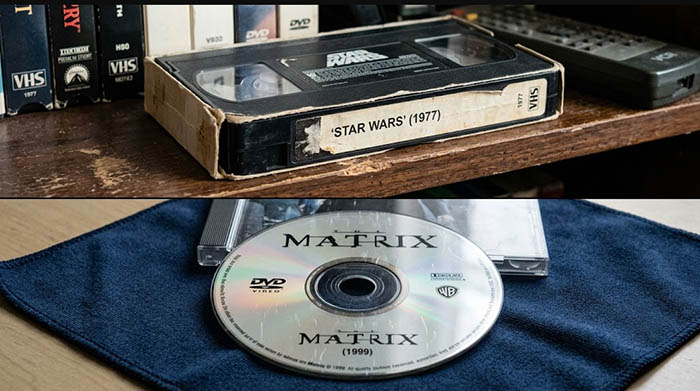
To visualize the core issue, think of tape degradation like a fading ink drawing on a window sill—the longer it sits in the sun and air, the fainter the lines become until the image disappears entirely. Meanwhile, disc rot is like rust eating through the floorboards of an old car; it doesn't matter how well you tune the engine, if the metal underneath dissolves, the vehicle simply will not run. If you leave your media sitting untouched on a shelf, time will eventually make the decision for you, rendering your collection unplayable.
 FAQs about VHS and DVD Comparison
DVD offers significantly better picture quality than VHS. DVD uses a digital 480p resolution that provides sharp details, accurate colors, and stable images. VHS is an older analog format with an equivalent resolution of roughly 240 lines, which is highly prone to static, color bleeding, and visual fuzziness.
Yes, VHS tapes naturally degrade over time even if they are never played. The magnetic particles on the tape lose their charge over 10 to 20 years, causing colors to fade and audio to muffle. Additionally, tapes stored in humid conditions frequently develop white mold, which can destroy the physical ribbon completely.
No, brand-new VCRs are no longer manufactured anywhere in the world. The final electronics manufacturer permanently ended production lines in 2016. To play old cassettes today, you must buy refurbished units or secondhand machinery on marketplaces like eBay.
Disc rot is a form of chemical decay that occurs when the internal reflective layer of a DVD oxidizes. This usually happens if moisture leaks through microscopic cracks in the protective plastic lacquer. It results in tiny pinholes or dark patches inside the disc, preventing the laser from reading data and causing permanent playback freezing.
The most secure method of preservation is converting physical media into digital files (MP4 or ISO formats). DVDs can be ripped directly to a computer using software in just a few minutes, while VHS tapes require a digital USB capture card hooked up to a working VCR to record the footage in real time.
External Sources:
1. VHS (Video Home System) Historical Overview - Wikipedia : Comprehensive historical and technical data detailing JVC's development of magnetic tape recording, the home video format war against Betamax, and early consumer recording features.
2. DVD (Digital Versatile Disc) Technical Specifications - Wikipedia : In-depth reference documentation on the transition to digital optical media formats, covering compressed 480p MPEG-2 video architectures, internal structural layers, and early interactive menus.
3. Magnetic Media: Audio and Video Tapes :This page provides information on the formats, playback methods, storage requirements, and preservation guidelines for electronic, dynamic media records—including magnetic tapes, grooved sound recordings, optical discs, and solid-state media.
4. Council on Library and Information Resources: Optical Media Longevity : A rigorous study outlining the scientific mechanics of optical disk errors, describing the manufacturing flaws and air/moisture leaks that lead to inner aluminum oxidation, commonly known as disc rot.
5. The Last VCR Manufacturer Ends Production - BBC News : Historical news coverage confirming Funai Electric's 2016 factory closure, documenting the total global shutdown of new videocassette recorder supply chains due to component shortages.
6. Evolution of Home Theater Audio Technology - Dolby Laboratories : Official corporate archive charting the acoustic progression from analog Hi-Fi tracking channels to true multi-channel Dolby Digital 5.1 surround sound architectures on consumer discs.


 Free Download
 Free Download