



 win
win

 Super Resolution
  Video Stabilization
  Frame Interpolation

 Denoise Image
  Restore Old Photo
  Unblur Image
  Recover Face
  Upscale Image
  Colorize Photo
 Video Conversion >
 Video Compression >
 Screen Recording >


HEVC Codec Explained and Free Download Methods
Summary: Want HEVC codec free on Windows 10/11? The Microsoft Store link no longer works for some users, but you can still get HEVC Video Extensions (free or official), install them in minutes, and fix the “missing codec” error.
"Does anyone know how to get the HEVC codec for free? I'm using win 11 and i know i can just use VLC or something but i need the HEVC video extension that's built in the windows media player." -- Reddit
HEVC codec, also known as H.265 or MPEG-H Part 2, is a cutting-edge video compression standard. It was designed primarily to deliver roughly 25–50% better compression at the same perceptual quality, or significantly higher quality at the same bitrate, than its predecessor, H.264.
However, Windows does not include native HEVC support by default, mainly because of patent licensing royalties associated with the codec. As a result, you may get the "missing HEVC codec" or "unsupported encoding settings" error with higher resolution videos such as 4K and 8K.
This guide introduces verified free, official download options, explains why HEVC fails on Windows, and offers solutions if it still doesn't work.
HEVC Codec Not Working Even After Installing It? Try Winxvideo AI
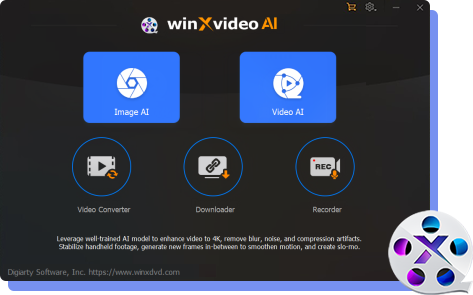
Even with the codec, HEVC still may fail if your PC lacks hardware decoding or struggles with certain HEVC variants. In this case, converting the file is the sure fix. Winxvideo AI converts HEVC to H.264/MP4 or ProRes with full hardware acceleration, eliminating compatibility problems so you can play or edit your HEVC videos smoothly.
Give Winxvideo AI a try and see how easily it fixes your HEVC playback issues.
Table of Contents
- Part 1. Microsoft Store HEVC Codec for Windows 11 / 10
- Part 2. Top Free Third-Party HEVC Codec Packs
- Part 3. VLC Media Player HEVC Codec
- Part 4. Convert HEVC to Fix Compatibility Issues for Playback and Editing (Recommended When Codecs Fail)
- Part 5. What Is HEVC Codec & Why Windows Requires Extensions
- Part 6. Why HEVC Videos Won't Play Even After Installing the Codec
- Part 7. FAQs
Part 1. HEVC Codec for Windows 11 / 10
Although Microsoft does not ship an HEVC decoder with standard Windows 10 or Windows 11 installations, you can still download the HEVC codec from the Microsoft Store.
1. HEVC Video Extensions
- Size: N/A
- System: Windows 10/Windows 11
The official Microsoft HEVC (High Efficiency Video Coding) extension is safe, reliable, and highly compatible, allowing HEVC videos to play on Windows apps and smart TVs with a simple installation.
However, it requires a separate installation instead of being built-in, may cause occasional issues that are difficult to troubleshoot, and offers no refund. It also demands specific hardware, like Intel 7th Gen CPUs and newer GPUs, limiting accessibility for older systems.
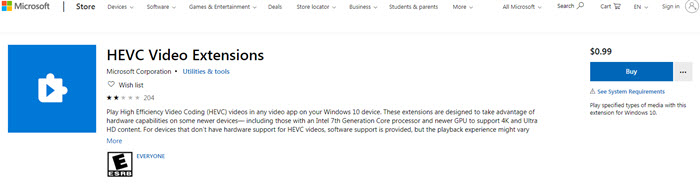
How to get HEVC Video Extensions download and installed on Windows 10/11
Step 1. Open the Microsoft Store or visit the HEVC Video Extensions page. Find the $0.99 package, click "Buy", and get the code via email.
Step 2. Enter the code and click "Install" to add HEVC Video Extensions to your Windows 10/11 PC.
Step 3. Click "Launch" after installation to play 4K HEVC H.265 videos in the Movies & TV app.
Microsoft provides automatic security updates, so enable "Update Apps Automatically" in Settings. Note that some users still face errors, like installation failures or inability to play HEVC/MKV videos.
2. HEVC Video Extensions from Device Manufacturer [FREE]
- Size: 7.0MB
- System: Windows 10 or higher
In fact, the Microsoft Store has two identical HEVC packages. Besides the $0.99 one, there is a free one called "HEVC Video Extensions from Device Manufacturer."
This free version was originally intended for OEM computers, such as pre-installed models from brands like Dell, ASUS, HP, and Lenovo. Since the manufacturers have already paid the licensing fees, end users don't need to pay again. This specific listing is usually hidden from the Store's search results.
Here's how to download and install the "HEVC Video Extensions from Device Manufacturer":
- Open your web browser.
- Copy and paste this exact address into the URL bar:
ms-windows-store://pdp/?ProductId=9n4wgh0z6vhq - Press Enter. A pop-up window will ask for permission to open the Microsoft Store. Click Open.
- The hidden page for "HEVC Video Extensions from Device Manufacturer" will appear.
- Click Install or Get.
Note: Microsoft has recently tightened restrictions around this page. It may no longer be possible to install this free HEVC video extension. You might receive a message stating that the extension will not work on your device. But you can still try your luck.
3. Free OEM HEVC Extension AppX – Direct Download
If the Microsoft Store prevents you from installing the free HEVC extension, you can bypass this restriction by downloading the official Microsoft .Appx package directly from a secure third-party website. Below are the download links:
- Free HEVC codec for Windows 10/11 (requires Intel 7th Gen+ CPU and newer GPU for 4K/Ultra HD): https://www.free-codecs.com/hevc-video-extensions-from-device-manufacturer_download.htm
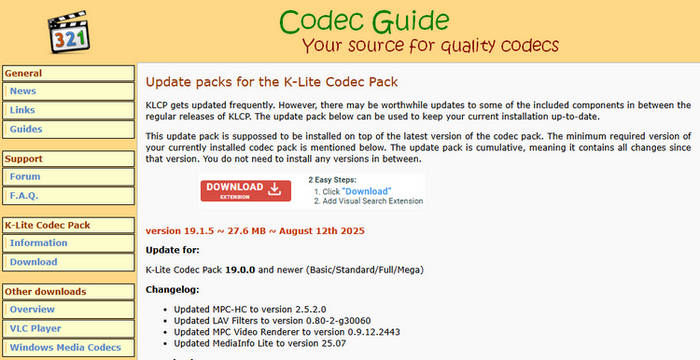
- HEVC extensions for GPUs with hardware-accelerated decoding: https://www.codecguide.com/media_foundation_codecs.htm
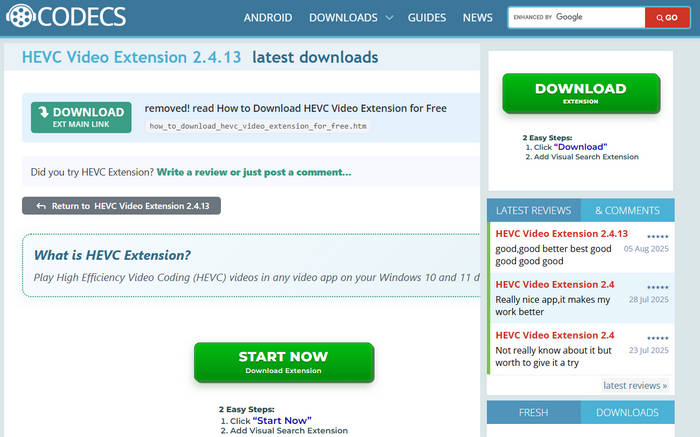
Simply enter the links into your browser, then you can select and download the 32-bit or 64-bit version of HEVC codec on your Windows. With the HEVC Video Extension downloaded and installed, you can also view .HEIC photos without further codecs.
 What if the HEVC Video Extensions won't work?
1. Sign out of your Microsoft Account, search for HEVC Video Extensions, then log in and reinstall.
2. Reset the Microsoft Store cache: Press Win + R, type wsreset.exe, and press OK.
3. Reset the Microsoft Store app: Settings > Apps & features > Microsoft Store > Advanced options > Reset.
Part 2. Top Free HEVC Codec Packs
Windows 10/11 lacks a built-in HEVC codec, so playing HEVC videos in Microsoft apps prompts a $0.99 extension purchase. How can you get HEVC codecs for free? Searching online often yields confusing results. Here are reliable HEVC (H.265) codecs for Windows 10/11 you can download safely.
1. K-Lite Mega Codec Pack
- Size: 59.7 MB
- System: Windows XP and later
- Best for: those who need more than just HEVC codec support
K-Lite Codec Pack[2] includes video/audio codecs, DirectShow filters, and VFW codecs, allowing software and Windows to play many formats. Since version 10.10, K-Lite Mega supports HEVC, letting you play HEVC videos free on Windows 10/8/7/XP (64 & 32 bit) without issues. Download K-Lite Codec Pack for HEVC and other formats.
K-Lite suits users wanting a convenient media player solution, while x265 is for creators needing efficient video compression. Encode with x265, then play with K-Lite.
2. x265
- Size: N/A
- System: Windows, macOS, Linux
- Best for: Open-source HEVC encoder, perfect for video creators needing compression control.
x265 is an open-source HEVC encoder library that lets users encode video/images into an HEVC bitstream. Available under GNU GPL 2 or a commercial license, it aims to provide the best HEVC/H.265 encoder with high speed and visual quality. Adopted by programs like FFMPEG, Handbrake, AviDemux, and Openshot, the latest version is v3.6 (1.6MB). You can download x265 v3.5 here. It offers many encoding parameters for professional-level compression control.
Using x265 fully requires some video encoding knowledge. Real-time encoding of very high-resolution videos (8K+) can be impractical on most consumer hardware.
Video Tutorial: Download HEVC Codec to Play HEVC Files on Windows 10/Windows 11
Part 3. VLC HEVC Codec
The Microsoft Store is not the only solution to this issue. If you simply want to play HEVC files, instead of using native Windows apps, you can opt for a media player that offers built-in HEVC/H.265 support:
- VLC Media Player
- 5KPlayer
- PotPlayer
VLC is one of the best media players for playing HEVC videos smoothly without installing any extra codecs. As long as you are running VLC version 2.1.1 or newer, the player has its own HEVC decoder to read the file.
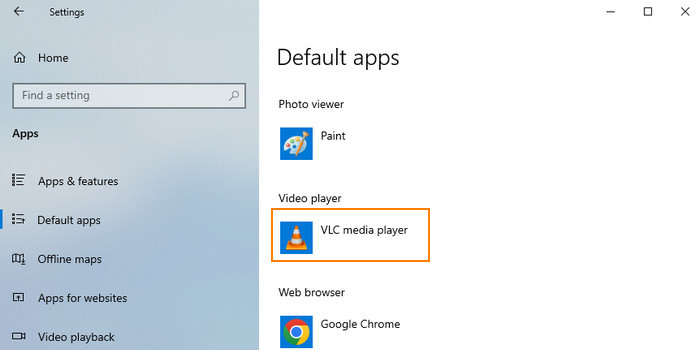
Simply download the latest version of VLC on Windows 10 or 11, go to Settings > Apps > Default Apps, and set VLC as your default video player. From then on, all HEVC video files will open smoothly in VLC — no codec errors, no extra downloads, no payments.
If you still can't play HEVC videos in VLC, the most common reason is likely a hardware acceleration problem. Follow the steps below to fix it:
- Open VLC. Go to Tools > Preferences > Input / Codecs.
- Find Hardware-accelerated decoding.
- Try these options one by one: Disable, Direct3D11, DXVA 2.0, Automatic.
- Save and restart VLC after each change.
Here's a detailed guide to fix VLC not playing HEVC videos.
Part 4. Convert HEVC to Fix Playback Issues (Recommended When Codecs Fail)
If your PC cannot decode HEVC smoothly or the codec still doesn't work, the most reliable solution is a video converter - converting HEVC/H.265 into a universally compatible format like MP4 (H.264).
A lightweight HEVC converter such as Winxvideo AI helps in these cases:
- Converts HEVC to MP4/H.264 for smooth playback on any Windows PC
- Supports iPhone/DJI/GoPro/DSLR HEVC variants
- Downscales 4K/8K to 1080p for low-end devices
- Uses GPU acceleration for fast transcoding
- Fixes black screens, stuttering, or import errors in editors
Try Winxvideo AI to convert HEVC videos smoothly and fix freezes, black screens, or editor errors.
Below are the simple steps to convert 4K HEVC H.265 to H.264.
- Download an HEVC converter such as Winxvideo AI. Open Winxvideo AI, select Video Converter, and then click the +Video button to load the HEVC video source.
- Choose MP4 H.264 as the output format by going to Video --> MP4 (H.264). You can get the best MP4 video converter here >>
- Check the box Hardware Acceleration Engine to make sure the HEVC transcoding is processed based on GPU for a fast conversion.
- Click the RUN button to begin the HEVC conversion.
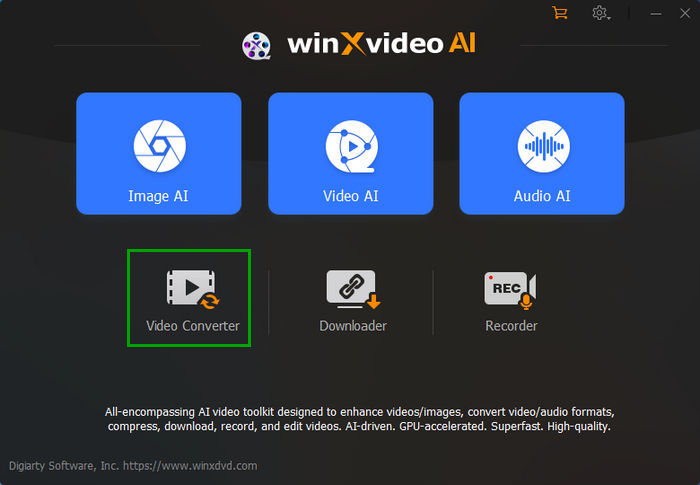
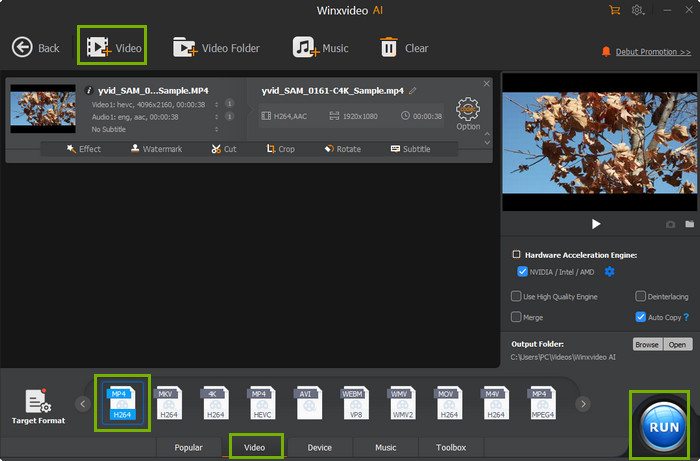
Follow the detailed tutorial to convert HEVC to H.264 for smooth 8k/4k/HD video playback.
Part 5. What Is HEVC Codec
HEVC/H.265[1] is a modern, high-efficiency video compression standard widely adopted by devices like iPhone, GoPro, DJI, and DSLR cameras, and it is the standard for 4K/8K UHD streaming and Blu-ray content. It achieves the same video quality at half the bitrate of H.264 by using advanced compression techniques such as motion compensation, intra-frame coding, coding tree units, and entropy coding to significantly reduce file size while maintaining high video quality, which enables efficient playback even at lower bitrates.
However, since Windows removed native HEVC support due to licensing costs, users must now install an extension or rely on a media player with built-in HEVC decoding to watch these files.
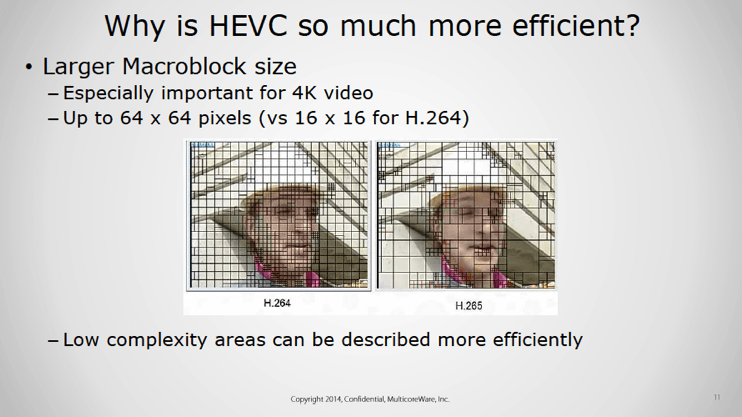
Benefits of HEVC
- 50% smaller files vs. H.264
- Higher detail and color accuracy
- Ideal for 4K, 8K, HDR, and HDR footage
- Requires less bandwidth for online video platforms.
Drawbacks
- Requires newer CPUs/GPUs
- Not preinstalled on Windows
- Some apps struggle with HEVC variants (e.g., hvc1)
What you may be interested in: H.265 vs H.264, HEVC vs VVC
Part 6. Why HEVC Videos Won't Play Even After Installing the Codec
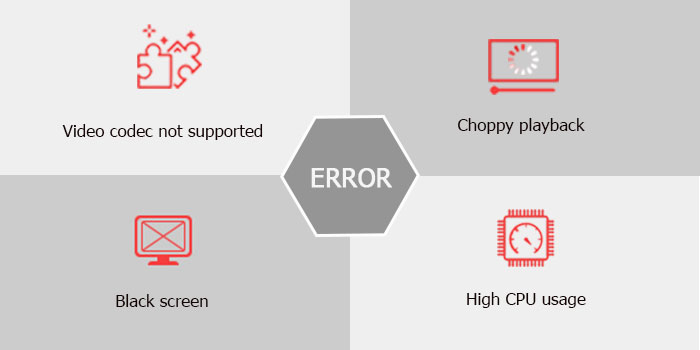
Even after installing an HEVC codec or extension, playback may fail on devices with insufficient hardware, especially for 4K UHD videos. Common issues include freezing, black screens with audio, or high CPU usage causing overheating. To fix this, first ensure your device supports HEVC. If problems persist, common causes include:
1. Hardware doesn't support HEVC decoding. Minimum requirements:
- Intel 6th gen (Skylake) or newer
- AMD Ryzen or newer
- Nvidia GTX 950 / 960 or newer
- AMD R9 Fury or newer
Make sure your device meets or exceeds these requirements for smooth HEVC playback, especially for high-bitrate or 4K/8K videos. Sufficient CPU and GPU power helps prevent stuttering, reduces CPU load, and ensures better overall performance.
2. The video is 10-bit, HDR, or high bitrate. Older PCs struggle with these formats.
3. Codec variant mismatch (hvc1 vs hev1). iPhone and DJI often use hvc1, which some Windows decoders cannot read.
4. Software limitations Even with the codec installed, programs like Premiere Pro, Filmora, or old WMP may reject HEVC.
Part 7. FAQs
1. Is HEVC codec free for Windows?
The official HEVC codec costs $0.99. A free version is available, but it should be downloaded only from reputable codec sites to ensure safety.
2. What's the easiest way to play HEVC?
VLC Media Player plays HEVC instantly without extra codecs. Sometimes, VLC can't play HEVC H.265 videos using the hvc1 codec due to missing decoders. In that case, convert the video to MP4. See the detailed guide to fix VLC HEVC playback errors.
3. Why can't Windows play iPhone HEVC videos?
iPhones use the hvc1 codec, which many Windows decoders don't support properly. Converting these videos to MP4 usually resolves the issue.
4. Does HEVC need special hardware?
Yes. Smooth playback of 4K HEVC videos requires modern CPUs and GPUs with HEVC support.
5. How do I add HEVC to Premiere Pro?
Adobe Premiere needs compatible hardware and the proper codec modules. If HEVC is rejected, converting the video to H.264 using a HEVC video converter is the most reliable solution.
External Source Links:
1. High Efficiency Video Coding (HEVC) [wiki]: also known as H.265 and MPEG-H Part 2, is a video compression standard, designed as a successor to the widely used Advanced Video Coding (AVC, H.264, or MPEG-4 Part 10).
2. K-Lite Codec Pack[wiki] is a collection of audio and video codecs for Microsoft Windows that enables an operating system and its software to play various audio and video formats generally not supported by the operating system itself. The K-Lite Codec Pack also includes several related tools, including Media Player Classic Home Cinema (MPC-HC), Media Info Lite, and Codec Tweak Tool.
3. Versatile Video Coding (VVC) [wiki] is a future video compression standard being developed for finalization around mid-2020 by the Joint Video Experts Team (JVET), a united video expert team of the MPEG working group of ISO/IEC JTC 1 and the VCEG working group of ITU-T. At times, it has also been referred to as Future Video Coding (FVC) and as ITU-T H.266. It will be the successor to High Efficiency Video Coding (HEVC, also known as ITU-T H.265 and MPEG-H Part 2).