


 win
win

 Super Resolution
  Video Stabilization
  Frame Interpolation

 Denoise Image
  Restore Old Photo
  Unblur Image
  Recover Face
  Upscale Image
  Colorize Photo
 Video Conversion >
 Video Compression >
 Screen Recording >


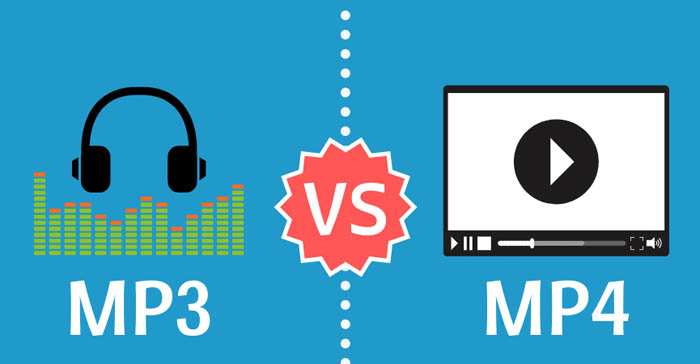
MP3 vs MP4 - Understanding the Differences Between MP3 and MP4
Many users download music online, but some files come in MP3 format while others are labeled as MP4, which can be a bit confusing. So, what’s the difference between MP3 and MP4? Which format should you save your files in? When comparing MP3 vs MP4, which one offers better audio quality? Is MP4 an audio format or a video format? Keep reading to learn the key differences between MP3 and MP4, and find out how to extract MP3 audio from an MP4 file without losing sound quality.
Convert MP4 Video Files to MP3 Audio without Losing Quality
With Winxvideo AI, you can convert MP4 video to MP3 audio format on Windows 11/10/8/7 and macOS. Its built-in High Quality Engine can make the program output original audio quality. The transcoding process won't decrease the sound quality. It can also convert MOV/AVI/WMV/FLV etc. to MP3, AAC, FLAC, and convert between tons of video formats.
Table of Content
Part 1. MP3 vs MP4: Detailed Format Comparison
For non-technical users, it can be difficult to understand the differences between two file formats like MP3 and MP4. To answer the question “what are the differences between MP3 and MP4?”, we researched the topic extensively and summarized the key distinctions below, including format types, audio quality, features, common misunderstandings, and more.
MP3 vs MP4: type of format
What is MP3? MP3, formally known as MPEG-1 Audio Layer III or MPEG-2 Audio Layer III, is a lossy audio compression format developed from MP2. First released in 1993, it was designed to significantly reduce audio file size by removing parts of PCM audio data that are less noticeable to human hearing. For most listeners, MP3 audio quality remains very close to the original uncompressed sound. Because of its efficiency, compatibility, and relatively small file sizes, MP3 has become one of the most widely used audio formats.
What is MP4? MP4 is based on Apple QuickTime .mov and MPEG-4 Part 12. Officially known as MPEG-4 Part 14, it was first released in 2001. Unlike MP3, MP4 is a digital multimedia container format that can store video, audio, subtitles, still images, and text. MP4 files support various video and audio codecs, including H.264, HEVC, VP9, MPEG, AAC, MP3, FLAC, and AC3, among others.
As you can see, MP3 and MP4 are completely different types of file formats. MP3 is designed specifically for storing audio and is commonly used by music players, streaming services, and portable audio devices. MP4, on the other hand, is mainly used for storing multimedia content such as video, audio, subtitles, and images.
MP3 vs MP4: audio quality and file size
Although MP3 uses lossy compression, it still offers a good balance between sound quality and file size. Compared with MP4 video files, MP3 files are usually much smaller because they only contain audio data. If you only want to listen to music on an MP3 player or save storage space, MP3 is often the more practical choice. Converting MP4 to MP3 can also greatly reduce file size when video is unnecessary.
If an MP4 file contains an MP3 audio stream, the audio quality will generally be the same as a standalone MP3 file encoded at the same bitrate and compression settings.
In some cases, MP4 files may deliver better audio quality than MP3 files, especially when they use more advanced audio codecs such as AAC. However, audio quality depends more on the codec and bitrate than on the MP4 container format itself.
Therefore, it is not entirely accurate to say that either MP3 or MP4 always offers better quality.
MP3 vs MP4: functions and features
MP3 is mainly used for storing, transferring, and playing audio files on digital audio devices. It can deliver near-CD-quality sound while keeping file sizes relatively small. Today, MP3 remains one of the most popular audio formats because of its strong compatibility and efficient compression.
Compared with the audio-only MP3 format, MP4 is far more flexible. It can store video, audio, subtitles, text, and images in a single file. MP4 also supports internet streaming and works with a wide range of codecs, including HEVC, H.264, MPEG, VP9, AAC, MP3, ALAC, and many others. This broad codec support gives MP4 much greater versatility than MP3.
MP3 vs MP4: storage efficiency
In terms of storage usage, MP3 files are significantly more efficient because they only contain compressed audio data. This makes them ideal for users who want to store large music libraries without consuming too much device space.
MP4 files usually take up more storage because they include additional elements such as video, subtitles, and metadata. Even when an MP4 contains only audio, its structure is still more complex than MP3, which can lead to slightly larger file sizes in some cases.
MP3 vs MP4: best use cases
MP3 is best suited for situations where audio-only playback is needed, such as listening to music, podcasts, audiobooks, or transferring files to portable audio devices. Its simplicity and small size make it ideal for offline listening and storage.
MP4 is better for multimedia use cases where both video and audio are required. It is commonly used for movies, online videos, presentations, and social media content. If visual content is important, MP4 is the more appropriate choice.
MP3 vs MP4: common misunderstanding
1. MP3 ≠ MPEG-3 and MP4 ≠ MPEG-4, so don’t confuse “MP3 vs MP4” with “MPEG-3 vs MPEG-4”.
2. MP4 files are not limited to video. MP4 is a multimedia container format that can also store audio, subtitles, images, and text.
3. A higher audio bitrate in an MP4 file does not automatically mean better sound quality than MP3. The actual quality depends on the codec, bitrate, and encoding settings used.
MP3 vs MP4: comparison table
|
MP3 |
MP4 |
Other names |
MPEG-1 Audio Layer III or MPEG-2 Audio Layer III |
MPEG-4 Part 14 |
Filename extension |
.mp3, .bit (before 1995) |
.mp4, .m4a, .m4p, .m4b, .m4r, and .m4v |
Initial release |
1993 |
2001 |
Purpose |
Mainly designed for audio playback and music storage. |
Designed for storing multimedia content, including video and audio. |
Type of format |
Audio format |
Container format |
Capability |
Audio only |
Audio, video, text, and images |
Internet media type |
audio/mpeg, audio/MPA, audio/mpa-robust |
video/mp4, audio/mp4 |
Extended from |
MP2 |
QuickTime File Format and MPEG-4 Part 12 |
Open format |
Yes |
Yes |
Free format |
Yes (patents expired) |
No |
Standards |
ISO/IEC 11172-3, ISO/IEC 13818-3 |
ISO/IEC 14496-14 |
Which has better quality? |
It depends on the codec and bitrate used. Audio quality in MP4 can be the same as, better than, or worse than MP3. |
|
Which has smaller file size? |
MP3 files are typically smaller than equivalent MP4 video files. |
|
In conclusion: Based on the comparison above, MP3 and MP4 serve different purposes. MP3 is primarily an audio format, while MP4 is a multimedia container format capable of storing various types of digital content. Because of these fundamental differences, comparing MP3 and MP4 directly is not always meaningful.
Part 2. FAQs about MP3 vs MP4
1. Is MP3 lossy or lossless?
MP3 is a lossy compressed audio format.
2. What's the difference between 128kbps and 320kbps MP3 file?
128 kbps MP3 file will be smaller than 320kbps MP3 file in size, remove more of the higher frequencies (>16 kHz) and have slightly more audible compression artifacts. There is an audible difference between 128 kbps and 320 kbps MP3 file, but how audible the difference will be mainly depends on the type of music you're compressing, e.g., many high frequencies, much percussion, etc., and your age.
3. Which MP3 bit rate should I use?
Generally, 128kbps is enough if you use the headphones that came with your player and don't listen to that much music. If you want to get better sound quality without increasing too much file size, you can try 256kbps. The highest quality MP3 bitrate is 320 kbps at 16 bit .
4. Will an MP4 player play MP3?
An MP4 player is probably an audio and video player and is likely able to play MP3.
5. How can I convert MP4 to MP3?
To convert MP4 to MP3 to keep audio stream only, you can use Free Video Converter. After downloading and installing this software, follow the three simple steps to finish the video to audio conversion.
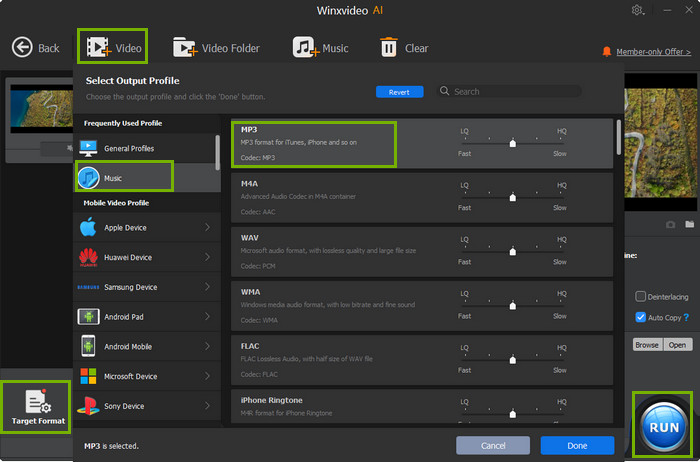
Step 1. Open Winxvideo AI and click + Video button to load the MP4 video you need to convert to MP3.
Step 2. On Output Profile panel, scroll down to "to Music", and choose MP3. Then, hit OK.
Step 3. Hit RUN button to begin converting MP4 to MP3 while keeping original quality.