



 win
win

 Super Resolution
  Video Stabilization
  Frame Interpolation

 Denoise Image
  Restore Old Photo
  Unblur Image
  Recover Face
  Upscale Image
  Colorize Photo
 Video Conversion >
 Video Compression >
 Screen Recording >


MKV vs MP4: 7 Key Differences Between MKV and MP4 Formats
MKV and MP4 are two widely used video container formats that are commonly seen in everyday media playback. In many cases, users find themselves converting MKV to MP4 or the other way around depending on their device or platform requirements. This often raises a practical question: which format is more suitable for your needs? To help clarify the differences, let’s take a closer look at MKV vs MP4 in terms of video quality, file size, and support for audio & video codecs, so you can choose the format that best fits your use case.

Convert (4K UHD ) MKV from/to MP4 without Re-encoding
If you need to convert between MKV and MP4 format, try Winxvideo AI. It's got this cool 'Auto Copy' mode that transforms MKV to MP4 in a flash, without messing with the quality. Talk about speedy and top-notch results! Thanks to Hardware Acceleration and the High-Quality Engine, you're in for a fast and high-quality ride. Plus, it's got your back with a variety of video and audio codec formats – MKV HEVC/VP9 to MP4 H.264, MP4 to MKV, WMV to M4V, MOV to MP4, and more. Ready for a smooth MKV to MP4 conversion? Give it a go!
Table of Contents
Part 1. Head-to-Head Comparison Between MKV and MP4
- #1. MKV vs MP4 - License
- #2. MKV vs MP4 - Supported Audio/Video Codec Formats
- #3. MKV vs MP4 - Subtitle Support
- #4. MKV vs MP4 - Quality
- #5. MKV vs MP4 - Size
- #6. MKV vs MP4 - Usage and Compatibility
- #7. MKV vs MP4 - File Extensions
Part 1. MKV vs MP4: Detailed Comparison
MKV and MP4 are two widely used multimedia container formats designed to store video, audio, subtitles, and images. They are also commonly used for online streaming and video playback. Although they serve similar purposes, they differ in structure, flexibility, and typical use cases.
#1. License
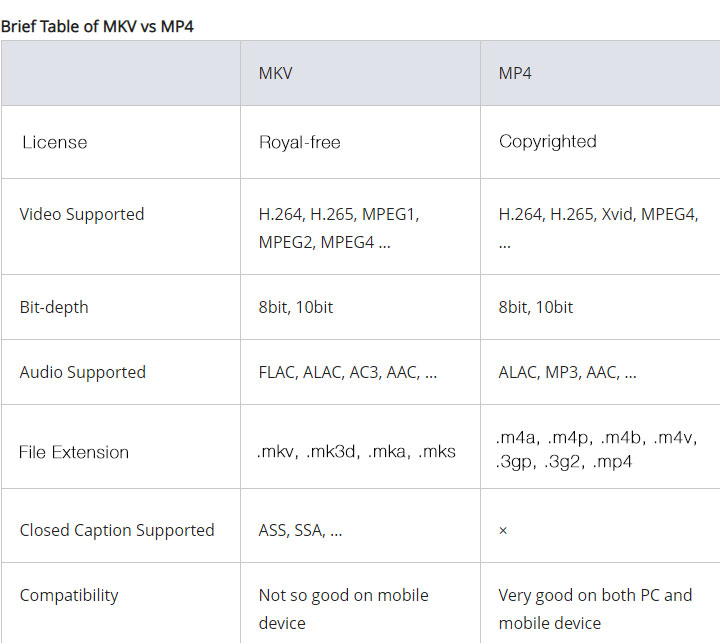
MKV is an open standard developed under a non-profit organization (Association loi 1901). It is generally considered royalty-free, with specifications available to the public under open licensing models, making it widely adopted in open-source projects and media tools.
MP4 (ISO/IEC 14496-14) is a standardized format maintained by the ISO organization. While it is also widely supported and freely used in practice, certain implementations may involve patented technologies depending on the codecs used inside the container.
#2. Supported Audio/Video Codec Formats
MKV supports a very flexible structure and can store multiple video, audio, subtitle, and image tracks in a single file. It is commonly used for movies, TV series, and high-quality media backups. In general, MKV is known for its broad codec compatibility and fewer restrictions compared to more standardized formats.
MP4 supports a wide range of commonly used codecs, including AAC, MP3, H.264/AVC, H.265/HEVC, VP9, and others. It is designed for efficient playback and broad compatibility across devices, operating systems, and online platforms.
Both MKV and MP4 support modern codecs such as H.265/HEVC, making them capable of handling high-resolution content like 4K and 8K video.
One key difference is that MKV supports lossless audio formats such as FLAC more naturally, while MP4 typically relies on formats like ALAC for lossless audio. FLAC is widely regarded as a highly efficient lossless compression format for digital audio preservation.
#3. Subtitle Support
MKV offers more advanced subtitle support, including formats like SSA and ASS, which allow rich styling, positioning, and multiple subtitle tracks. MP4 supports subtitles as well, but with more limited flexibility compared to MKV.
#4. Quality
Which is better, MKV or MP4? In terms of quality, neither format has an inherent advantage. Video quality depends entirely on the codec, bitrate, and encoding settings used inside the container.
If MKV and MP4 contain the same video and audio codecs with identical settings, the final output quality will be the same, since the container itself does not affect visual or audio fidelity.
#5. Size
Are MKV files larger than MP4? Not necessarily. File size is determined by encoding parameters such as bitrate, resolution, and compression efficiency rather than the container format itself.
However, MKV files are sometimes larger in practice because they often include multiple audio tracks, subtitle tracks, or less compressed source material. On the other hand, more efficient encoding settings can sometimes make MKV files smaller than MP4.
#6. Usage and Compatibility
Best scenarios for using MKV
- Archiving high-quality videos: MKV is widely used for preserving original video and audio quality without strict compression limitations, making it suitable for long-term storage and media archiving.
- Multi-track media storage: MKV is ideal for content with multiple audio tracks, subtitles, or commentary tracks, as it can store them all in a single file while maintaining flexibility.
Optimal situations for MP4:
- Online streaming and sharing: MP4 is the most commonly used format for platforms like YouTube, Instagram, and Facebook due to its broad compatibility and efficient compression.
- Cross-device compatibility: MP4 plays smoothly on almost all devices, including smartphones, tablets, PCs, and smart TVs, without requiring additional codecs.
- Balanced quality and file size: MP4 provides efficient compression while maintaining good visual quality, making it suitable for storage-limited or distribution-focused scenarios.
#7. File Extensions
MP4 files commonly use the .mp4 extension, but related formats such as .m4a, .m4b, .m4v, and .3gp are also based on the same underlying standard and serve different purposes depending on the content type.
- .m4a - Audio-only MPEG-4 files, typically unprotected.
- .m4p - Encrypted audio files used in DRM-protected ecosystems such as iTunes.
- .m4b - Audiobooks and podcasts with chapter support.
- .m4v - Video files commonly used in Apple ecosystems and encoding tools like HandBrake.
- .3gp / .3g2 - Legacy mobile video formats based on MPEG-4 standards.
MKV typically uses the .mkv extension for video content, while other variants include .mka (audio-only), .mk3d (stereoscopic video), and .mks (subtitles). Among these, .mkv remains the most commonly used format for general video playback.
Part 2. MKV vs MP4 - Which Format to Choose
In summary, MP4 offers better overall compatibility and is supported across most mobile devices, operating systems, and online platforms. MKV is more commonly used for high-quality video storage and advanced media features, but it often results in larger file sizes due to its flexibility.
In the MKV vs MP4 comparison, it is not accurate to assume that MKV is always larger or that it always provides better quality. Both formats are container types and do not directly determine video quality or file size. Instead, factors such as codec, bitrate, and encoding settings play a much more important role.
So which format should you choose, MKV or MP4? The answer depends on your specific needs and how you plan to use the video.
If you are ripping DVDs and want to preserve multiple audio tracks, subtitles, and maximum flexibility, MKV is a strong option—provided your playback devices support it. On the other hand, MP4 is generally the safer choice for everyday playback on Android devices, game consoles, and most online platforms. In many cases, converting DVD content to MP4 with H.264 encoding offers a good balance between quality, file size, and compatibility.
Part 3. FAQs about MKV and MP4
1. How do I convert MKV to MP4?
It's easy to convert MKV to MP4, especially with the best video converters like Winxvideo AI. After downloading and installing this software on your computer, you can convert video format from MKV to MP4 within 3 simple steps.
- Step 1. Open Winxvideo AI, select Video Converter, and click the + Video button to load the MKV files you want to convert to MP4.
- Step 2. Choose a desired MP4 preset. There are MP4 presets for PC, Mac, Apple, Android, TV, YouTube, and more.
- Step 3. Hit RUN to begin converting MKV to MP4. If you want to convert MKV to MP4 without re-encoding, you should check Auto Copy before hitting the RUN button.
2. For streaming over Plex, which video format is better, MKV or MP4?
MKV is more versatile and can be played on Plex if it is encoded with supported video audio codecs. However, MP4 is easier to direct play in Plex (better stream, less buffering).
3. Assuming file sizes are the same, what format has better quality video, MKV or MP4?
Both MKV and MP4 are container formats and can't determine the quality of a video. It is the encoding of the video inside the container that matters. If a H.265-encoded MKV file is the same size as a H.264-encoded MP4 file, the MKV file should have better quality because the encoding format H.265 is superior to H.264 offering from 25% to 50% better data compression at the same level of video quality.
4. MKV VP9 vs MP4 H.264, which to choose?
In this case, we should compare VP9 and H.264. VP9 is a fairly new video format invented by Google as a royalty-free alternative to the heavy patented HEVC/H.265 format, aiming to reduce the file size of 4K video which would simply require much more server capacity with older video formats like H.264. So when downloading online video you should choose VP9 if you want the highest quality like 1080p or 4K. However, VP9 isn't a good choice for lower resolutions because it takes a lot longer to encode video to VP9 with the same quality as a well-encoded H.264 video.
5. Should I save my movies in MP4 or MKV?
It depends on your purposes. In general, MP4 format is preferred because it is more popular. It is accepted by almost all media players, video editing software, video-sharing sites, and more.
6. Should I convert DVD to MKV or MP4?
It depends on where you want to use the digital copy and which codec you want to choose. If the video and audio codec you want to use can't be wrapped in MP4, then you can use MKV. For example, if we choose MKV container format on HandBrake, the available video codecs include H.264, H.265, MPEG-2, MPEG-4, Theora, VP8, and VP9. But if we choose MP4, we can only choose between H.264, H.265, MPEG-2 and MPEG-4.
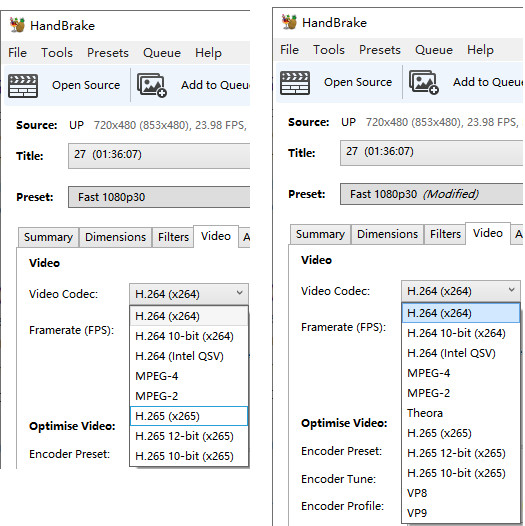
MP4 has broader support than MKV. If the media player you want to play the digital copy on doesn't support MKV, you should choose MP4.
7. To create videos for uploading to YouTube, should I choose MP4 or MKV?
If you want to create video for YouTube, YouTube suggests you use MP4. For more details about recommended upload encoding settings, click here.
But if you record video with OBS, koala - an active member on OBS forum warned that you should never record directly to MP4. It is advisable to always record to *.mkv and let OBS remux to *.mp4 after recording by setting Settings -> Advanced -> Recording -> Automatically remux to mp4. koala said:
Any video recorded directly to mp4 is usable only, if OBS is able to finalize the video. If it isn't able to finalize the video, the video is in its entirety unreadable. OBS isn't able to finalize, if it crashes mid-recording, or if the computer crashes or has a bluescreen, or if OBS hangs, or if the disk becomes full. If all this doesn't apply to your environment, you will have no issues with directly recording to mp4. But if something bad happens, the mp4 will be broken beyond repair, so don't complain if that happens.
We had many heartbroken posts in the forum with something like: "I just did the raid of my life in my game, but the computer crashed afterwards. Now my recording is broken. What can I do?" or even "I just recorded the marriage of my child, but my computer crashed. Now my recording is broken. What can I do?" The only answer to all this is "it's gone", if the recording format turned out as mp4.