









What's the Best Format to Rip a DVD? ISO, MKV, MP4 or H.265
"I am now digitizing the DVD collections. I want to rip my DVDs into a format so I could permanently keep a copy on the hard drive within reasonable storage constraints and at the same time having a format that would maintain a reasonable resolution when I would extract scenes for my home movie projects. So what is the best format to rip DVDs for archiving DVD home movies?"
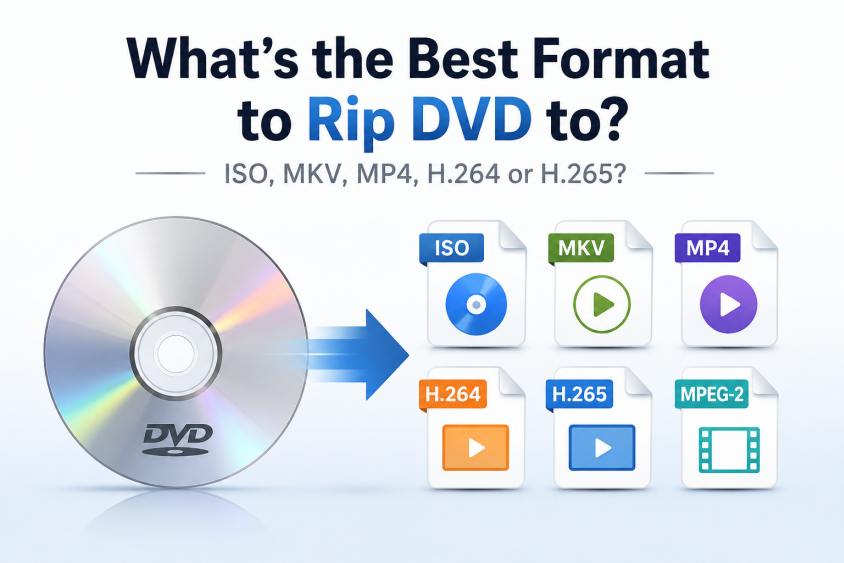
When digitizing a DVD collection, one of the most important decisions is how to store the ripped content. What is the best format to rip DVD to? Should you use an ISO image, VIDEO_TS folder, MPEG-2, MKV, MP4, H.264 or H.265/HEVC? The confusion comes from the fact that these terms do not all describe the same type of thing. ISO is a disc image, VIDEO_TS is the DVD-Video folder structure, MKV and MP4 are containers, while MPEG-2, H.264, and H.265/HEVC are video codecs.
There is no single best DVD ripping format. The right choice depends on whether you want full-disc preservation, original video quality, smaller files, or playback compatibility..
Short Answer: What's the Best Format to Rip a DVD?
Your Goal |
Best Choice |
Preserve the entire DVD and its original disc structure. |
ISO |
Keep DVD structure on your hard drive. |
VIDEO_TS |
Preserve the main movie with original quality. |
MPEG-2 / remuxed MKV |
Play DVDs on Plex or other media server with multiple audio, subtitle, and chapter tracks. |
MKV |
Create smaller files with broad device compatibility. |
MP4 + H.264 |
Reduce file size for your large libraries to save storage space. |
H.265/HEVC |
Watch your DVD videos on a phone or tablet. |
MP4 + H.264 |
Note: The term "DVD format" can refer to different parts of the ripping workflow, including disc images, DVD folder structures, containers, and video codecs. The best choice depends on whether you want to preserve the entire disc, keep the original video without re-encoding, save storage space, or maximize playback compatibility.
What Should You Know Before Choosing a DVD Ripping Format?
Before comparing DVD ripping options, it helps to understand that ISO, VIDEO_TS, MKV, MP4, and video codecs such as MPEG-2, H.264, and H.265 are not all the same type of format.
Type |
Examples |
What It Does |
Disc image |
ISO |
Stores the DVD as a single image file |
DVD-Video structure |
VIDEO_TS |
Stores the DVD's video, audio, navigation, and related files in the original folder structure |
Container |
MKV, MP4 |
Holds video, audio, subtitles, chapters, and other streams |
Video codec |
MPEG-2, H.264, H.265/HEVC |
Encodes and compresses the video |
For example, MP4 and H.264 are not competing formats at exactly the same level. MP4 is a container, while H.264 is a video codec that can be stored inside an MP4 file. The same applies to MKV: an MKV file can contain MPEG-2, H.264, H.265, and other video codecs.
This distinction matters when choosing a DVD ripping format because you may be choosing how much of the original DVD to preserve and separately choosing how the video should be encoded.
There is no single best format for every DVD ripping scenario. The right choice depends on whether you want to preserve the entire disc, keep the original movie quality, save storage space, or maximize playback compatibility. Below are the best formats to rip DVD for different use cases.
Best Format to Rip DVD for Quality and Archiving
If your priority is preserving DVD quality, the key question is whether you want to keep the entire DVD or only preserve the main movie. Preserving original quality does not mean converting DVD video to a lossless codec; it means avoiding additional lossy re-encoding. For full-disc preservation, ISO or VIDEO_TS is the better choice. If you only need the movie and want it in a standard video file, you can extract the original MPEG-2 video or remux (repackage without re-encoding) it into a container such as MKV.
1. Rip DVD to ISO
An ISO image is a single file containing the DVD's disc data and structure. When a DVD is copied to ISO without re-encoding the video, the original DVD video is preserved without additional encoding loss. ISO is therefore a strong choice for long-term DVD archiving when you want to retain the disc as completely as possible. It can also be mounted or opened by compatible software and can be used to reproduce the original disc later.
The main disadvantage is file size. A full DVD image can require several gigabytes of storage, so ISO is not the most storage-efficient option for a large DVD collection.
Best for: DVD collectors who want a complete digital backup of the original disc.
Not ideal for: Users who want the smallest possible files or maximum compatibility with modern media devices.
Check the detailed guide on how to copy DVD to ISO image >>
2. Rip DVD to VIDEO_TS folder
A VIDEO_TS folder preserves the DVD-Video structure as a collection of files rather than a single ISO image. It typically contains VOB, IFO, and BUP files. VOB files contain the DVD's presentation data, including video, audio, and subtitles, while IFO files provide navigation information and BUP files serve as backups of the IFO files.
Like an ISO backup, VIDEO_TS can preserve the original DVD video without re-encoding. The main difference is that the content remains in its original folder/file structure.
Best for: Users who want to retain the DVD-Video structure directly on a hard drive.
Trade-off: It is less convenient than a standard MKV or MP4 file for many modern media-library workflows.
Check detailed guide on how to copy DVD to VIDEO_TS folder >>
3. Rip DVD to MPEG-2
MPEG-2 is the video codec commonly used for DVD-Video. If you extract the original MPEG-2 video without re-encoding, you can preserve the source video quality while removing some of the disc-level structure. This makes MPEG-2 useful when you want to keep the main movie at its original video encoding rather than create a smaller compressed copy.
However, MPEG-2 is less storage-efficient than H.264 or H.265/HEVC. The resulting file can therefore be considerably larger than a re-encoded version of the same movie. DVD-Video commonly stores MPEG-2 video with audio such as Linear PCM, AC-3, or MPEG audio. DVD-Video also uses different standards, such as NTSC and PAL, with different native resolutions.
Disc |
Picture Standard |
Format |
Resolution |
DVD |
NTSC |
MPEG-2 |
720x480 |
DVD |
PAL |
MPEG-2 |
720x576 |
Important: DVD video is already compressed using MPEG-2. Converting it to a "lossless" format cannot restore detail that was not present in the source. If you want to avoid additional quality loss, preserve the original DVD data or extract/remux the original video rather than re-encoding it.
Check the detailed guide on how to copy DVD to a single MPEG-2 file >>
4. Rip DVDs to MKV
MKV is a container, not a video codec. It can store video, audio, subtitles, chapters, and multiple tracks in one file. This makes MKV a useful choice when you want a flexible movie file while retaining multiple audio or subtitle tracks. If the original DVD video is remuxed into MKV without re-encoding, the video quality remains the same as the source. However, MKV itself is not inherently lossless. An MKV file can contain MPEG-2, H.264, H.265/HEVC, or other codecs.
Best for: Movie libraries, Plex, multiple audio/subtitle tracks, and chapter-based organization.
Best Format to Rip DVD for Hard Drive Storage
ISO, VIDEO_TS, and original MPEG-2 can preserve the DVD video without additional re-encoding, but they generally require more storage. If you have a large DVD collection and want to balance quality, file size, and compatibility, H.264 and H.265/HEVC are more practical choices.
1. Rip DVD to H.264
H.264 offers a good balance between video quality, file size, encoding speed, and compatibility.
For a DVD collection stored on an external hard drive, MP4 + H.264 is a practical general-purpose choice when you want the files to work across many devices and applications.
Best for:
- Broad playback compatibility
- Smaller files than original MPEG-2
- Phones, tablets, TVs, computers, and media players
- Users who want a simple MP4-based library
Learn how to rip DVD to H.264/MP4 >>
2. Rip DVD to H.265
H.265/HEVC can provide similar perceived quality at a smaller file size than H.264, although the actual savings depend on the source and encoding settings. H.265 is a good option for a large DVD library where storage efficiency matters.
The trade-off is compatibility. Some older devices and playback environments may have limited HEVC support, and H.265 encoding can also require more processing power. So:
- Choose H.264 if compatibility is your priority.
- Choose H.265/HEVC if reducing storage space is more important and your playback devices support HEVC.
Best Format to Rip DVD for Plex
For Plex, MKV is a flexible container choice, but the best codec depends on your playback devices and whether Plex can Direct Play the file. The exact codec inside the MKV can vary:
- MKV + original MPEG-2 — preserves the original DVD video without re-encoding.
- MKV + H.264 — reduces file size while maintaining broad compatibility.
- MKV + H.265/HEVC — can reduce storage requirements further if your playback devices support H.265.
Plex playback can also depend on the client device and whether the file can be Direct Played or needs transcoding. Therefore, there is no need to treat MKV as universally superior to MP4; the best choice depends on your Plex clients and desired storage efficiency.
Best Format to Rip DVD for Mobiles
For phones and tablets, MP4 + H.264 remains a practical general-purpose choice because it combines relatively small files with broad device support. Instead of relying on fixed specifications for individual phone models, check the actual device and playback app you plan to use.
For DVD content, there is also little benefit in increasing the resolution beyond what the source can provide. Keeping the original aspect ratio and using an appropriate H.264 preset is usually more sensible than upscaling a DVD during the ripping process.
Best general choice: MP4 container + H.264 video
Best for: iPhone, iPad, Android phones, tablets, and general mobile playback.
Best Format to Rip DVD for TV
The best format for playing a ripped DVD directly on a TV depends on the TV model, operating system, media player, and playback method.
If you plan to play the file from a USB drive, MP4 + H.264 is a practical starting point because of its broad compatibility. However, always check your TV manufacturer's specifications for supported containers, video codecs, audio codecs, and maximum resolutions.
If the TV is connected to Plex or another media server, the media server and client device also affect which formats can play directly without transcoding.
Best general choice: MP4 + H.264
If your TV specifically supports MKV or H.265: MKV/H.265 can be considered when you want to retain additional tracks or reduce storage space.
Best Format to Rip DVD for NAS
A NAS can serve two different purposes: long-term storage and media streaming. The best DVD format therefore depends on what you plan to do with the files.
- For maximum preservation: Choose ISO or VIDEO_TS if you want to retain the original DVD structure and video without re-encoding
- For a flexible media library: Choose MKV if you want one movie file that can retain multiple audio tracks, subtitles, and chapters.
- For smaller files: Choose MP4 + H.264 for a balance of compatibility and file size.
- For maximum storage efficiency: Choose H.265/HEVC when your media server and playback devices support H.265.
If you plan to edit the ripped DVD footage for home movie projects, check your editing software's supported containers and codecs before choosing the final format.
Once you've chosen a format that matches your needs, you can download a DVD ripper to rip the DVD to the format accordingly.
How to Rip a DVD to Your Chosen Format
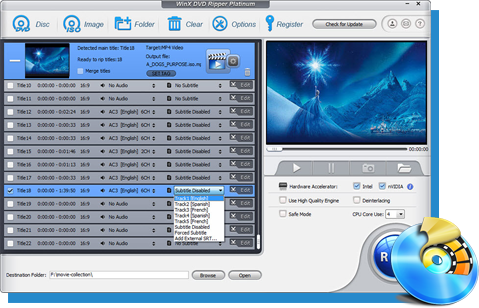
If you want to rip DVDs for different playback or storage purposes, WinX DVD Ripper Platinum supports DVD backups as well as conversion to common containers and codecs, including ISO, VIDEO_TS, MPEG-2, MP4, MKV, H.264, and H.265/HEVC. With it, you can
- Rip DVD to ISO, VIDEO_TS, or MPEG-2 format for the best quality, audio tracks, subtitles/captions, and menus.
- Convert DVD to MP4 H.264 for broad compatibility and smaller files or digitize DVD to H.265 when storage efficiency is more important and your playback devices support H.265.
- Use device-oriented presets when preparing DVD videos for TVs, phones, tablets, and other playback devices.
- Rip DVDs protected by region codes, CSS, RCE, Disney 99-title DRM, as well as homemade DVDs, old and even scratched DVDs.
Free download WinX DVD Ripper Platinum to rip DVD to the best format you need.
Please DO NOT use WinX DVD Ripper to rip rental DVDs.
For Windows and Mac only. If you are a mobile user, please click here
Below are the detailed steps to rip DVD to the preferred formats as per your needs
Step 1. Load the DVD. Insert the DVD into your computer and open it with your DVD ripping software.
Step 2. Choose the right DVD output format. Select the format based on your goal:
- ISO for complete DVD preservation
- VIDEO_TS for DVD folder structure
- MPEG-2 for the original DVD video
- MKV for flexible media libraries
- MP4 + H.264 for broad compatibility
- H.265/HEVC for smaller files
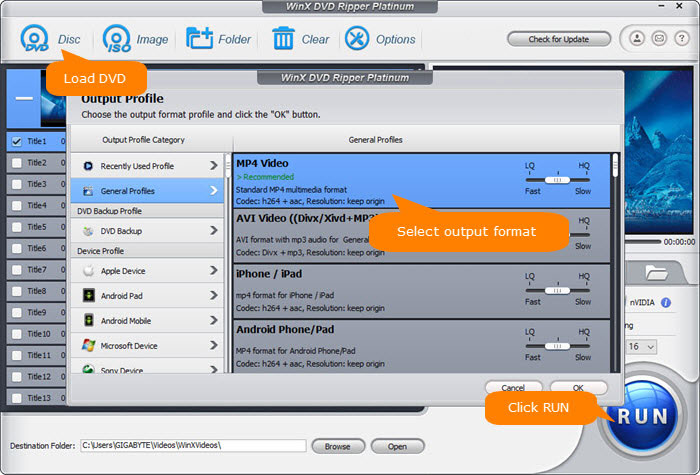
Step 3. Select the content. Choose the main title or other titles you want to keep, along with the audio tracks and subtitles you need.
Step 4. Start ripping. Start the ripping or conversion process and save the resulting file to your hard drive or NAS.
For format-specific instructions, use the detailed guides linked in the relevant sections above rather than repeating the same workflow on every page.
Legal Disclaimer: WinXDVD, developed by Digiarty Software, is designed strictly for personal, non-commercial media backup under fair use. Digiarty Software strictly respects copyright laws and does not condone, facilitate, or support copyright infringement or unauthorized copying. Users are advised to check and comply with their local DVD copyright laws and regulations before use.