



 win
win

 Super Resolution
  Video Stabilization
  Frame Interpolation

 Denoise Image
  Restore Old Photo
  Unblur Image
  Recover Face
  Upscale Image
  Colorize Photo
 Video Conversion >
 Video Compression >
 Screen Recording >


DaVinci Resolve Supported File Formats
DaVinci Resolve supports many professional video formats—but compatibility depends heavily on codecs, bit depth, and system version. If your footage fails to import, it’s usually due to unsupported H.265 profiles, 10-bit encoding limits, or variable frame rate issues. Below is a clear guide to supported formats and conversion solutions.
Video not Importing to DaVinci Resolve? Convert to DaVinci Resolve Supported Format
DaVinci Resolve supports a few file formats including MP4 and MOV, but not importing issue happens frequently. To solve that, you should convert videos to DaVinci Resolve supported formats and codecs first with Winxvideo AI, and then import it to the software.
Table of Contents
Part 1. What Formats Does DaVinci Resolve Support?
If you can’t import a video into DaVinci Resolve, the issue is usually not the file extension—but the codec inside the file. For example, an MP4 file may contain H.264, H.265, or even unsupported variable frame rate encoding.
Below is a clear breakdown of what formats and codecs are commonly supported in the latest version of DaVinci Resolve, along with important differences between the Free and Studio versions.
Commonly Supported Video Containers
- MOV (QuickTime)
- MP4
- AVI
- MXF
- R3D
- DPX / EXR
- CinemaDNG
Commonly Supported Codecs
- H.264 (8-bit)
- Apple ProRes
- DNxHD / DNxHR
- ARRIRAW
- Blackmagic RAW
- JPEG / JPEG2000
Important: MKV files are supported in version 17.2 and newer — but only if the internal codec is compatible.
Free vs Studio Codec Support (Most Asked Differences)
Free vs Studio: Real Codec Differences
Feature |
Free Version |
Studio Version |
| H.264 Support | Yes | Yes |
| H.265 (8-bit) | Supported (OS dependent) | Full Support |
| H.265 (10-bit) | Software decode only | GPU accelerated |
| Hardware Encoding | Limited | Full |
| Advanced GPU Acceleration | Limited | Yes |
Note: HEVC support varies depending on operating system and installed system codecs. On Windows, HEVC extensions from Microsoft may be required.
Note: Compatibility may vary depending on your operating system (Windows / macOS), GPU, and installed codecs.
Why Some Supported Files Still Fail to Import
- Variable frame rate (VFR) recordings
- 10-bit HEVC in Free version
- Unsupported audio codecs inside MKV
- Corrupted metadata
If your video is not recognized or fails to import smoothly, converting it to a fully compatible format such as MOV (ProRes) or MP4 (H.264 constant frame rate) can usually fix the problem. A reliable video converter like Winxvideo AI can help re-encode problematic files for smooth editing.
For a complete list of supported codecs and detailed information on decode/encode capabilities in DaVinci Resolve, please refer to the official Blackmagic Design documentation: DaVinci Resolve Supported Codec List (PDF).
Part 2. How to Import Video to DaVinci Resolve for Editing?
Now that you have known the video/audio/image formats and codecs supported by DaVinci Resolve, you can import a file to this video editor to starting video editing. To save your time, below are quick steps.
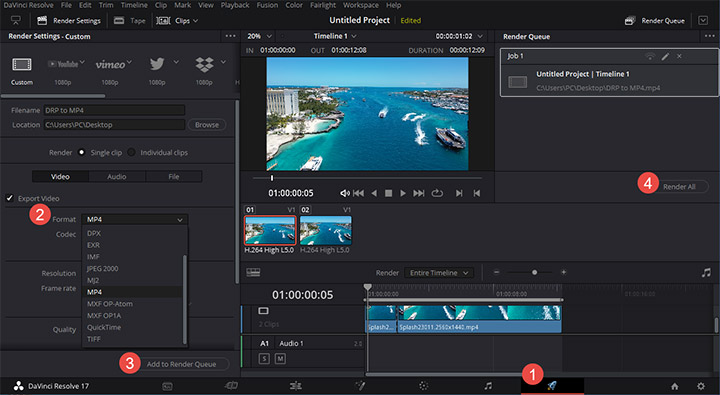
Step 1. Launch DaVinci Resolve on your computer.
Step 2. Click New Project, and enter a name for the new project.
Step 3. Import the video or videos to starting editing, by clicking the Media tab at the bottom.
Step 4. Click the Edit tab at the bottom and you can add visual effects and more.
Step 5. Click the Deliver tab at the bottom, then the settings window will pop up.
Step 6. Move your mouse to the upper left corner, and the Custom setting is selected by default. Here, just check the box next to Export Video.
Step 7. Choose MP4 from the drop-down menu next to Format.
Step 8. Click on Add to render queue.
Step 9. Under Render Queue, click on Render All to start exporting DaVinci Resolve video.
BTW, not importing files to DaVinci Resolve issue can be tackled with a video format converter, and below word are about how to convert videos to DaVinci Resolve supported video formats with Winxvideo AI.
Part 3. How to Solve Videos not Importing to DaVinci Resolve?
If errors and crashes like "Failed to read video track information from file" happen when trying to import videos to DaVinci Resolve, chances are that the unsupported file format is imported such as MKV and WMV. So, Winxvideo AI is here to help convert any files to DaVinci Resolve supported file formats.
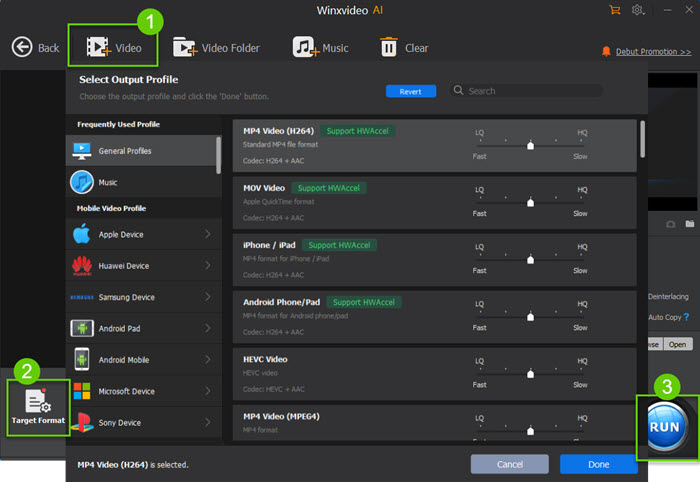
Step 1. Download Winxvideo AI, install and launch it on your computer.
Step 2. On the main UI, click on "Video Converter" button to navigate to the video conversion window.
Step 3. Click on the "+ Video" button to add your video.
Step 4. When the Output Profile window pops up, navigate to General Profile and choose MP4 Video (h264+aac) as the output format as it has been proved to be the best video format for DaVinci Resolve to process.
Step 5. Optionally, you can click the Edit button to trim/crop your video or add subtitles, and click the Settings button to adjust video frame rate, aspect ratio, resolution, etc.
Step 6. When everything is done, click the Browse button to select a destination folder and then hit the RUN button to start converting your file to DaVinci Resolve supported file format.
FAQs About DaVinci Resolve Formats
1. Does DaVinci Resolve support MP4?
Yes. DaVinci Resolve supports MP4 files encoded in H.264. Both Free and Studio versions can decode and export H.264 MP4. However, hardware acceleration for H.265 (HEVC) decoding and encoding is limited to the Studio version on Windows and requires compatible GPU support.
2. Does DaVinci Resolve support MKV files?
Support for MKV has improved in recent versions. Newer releases can import certain MKV files, but compatibility depends on the codecs inside the container. Many users report issues with variable frame rate or unsupported audio formats, which may require remuxing or conversion before editing.
3. Why can’t DaVinci Resolve import my MP4 file?
This is one of the most common forum complaints. The issue is usually codec-related rather than file format. Resolve Free on Windows does not support certain 10-bit H.264/H.265 files. Converting to an intermediate codec like ProRes or DNxHR typically resolves the problem.
4. Does DaVinci Resolve support variable frame rate (VFR) videos?
Variable frame rate footage, common from screen recordings and smartphones, often causes audio sync issues. Forum discussions frequently recommend converting VFR footage to constant frame rate (CFR) before importing into Resolve to ensure stable playback and editing accuracy.
5. What is the difference between DaVinci Resolve Free and Studio in format support?
The Studio version offers broader codec support and full GPU acceleration for H.265 encoding and decoding. The Free version has limitations, especially with certain 10-bit and hardware-accelerated formats on Windows, which often leads users to upgrade when working with modern camera footage.