










HandBrake vs MakeMKV: Compare Speed, Quality, File Size and More
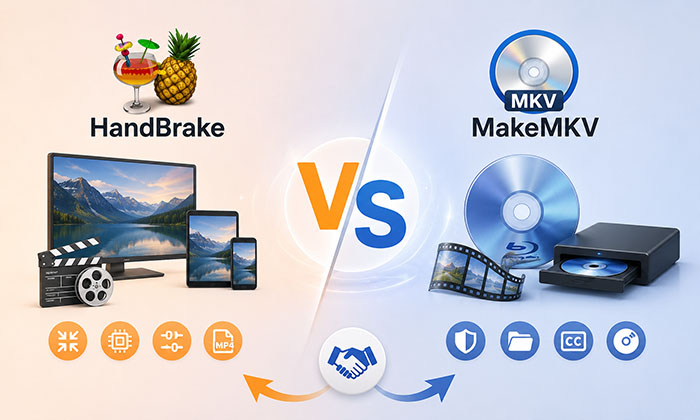
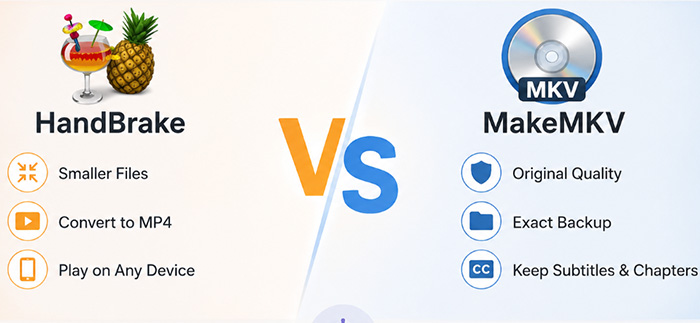
Handbrake vs MakeMKV, MakeMKV is the better choice if your goal is preserving original quality. If you want smaller files or MP4 output, HandBrake is the better option. In reality, many experienced users use both: MakeMKV first for a lossless rip, then HandBrake for compression. To help you make the right choice, we've compared HandBrake and MakeMKV across the factors that matter most, including ripping capability, output quality, file size, supported formats, copy protection, encoding speed, ease of use, and Plex compatibility.
Part 1. HandBrake vs MakeMKV: Quick Answer
MakeMKV and HandBrake aren't direct competitors, they're designed for different tasks. MakeMKV specializes in creating lossless DVD and Blu-ray backups, while HandBrake focuses on compressing and converting videos into smaller, more compatible formats. The table below helps you quickly decide which tool best matches your needs. For more options, see our Best DVD Ripper Software roundup.
|
HandBrake vs MakeMKV: Which One Should You Choose? |
|
If you want to... |
Best Choice |
Keep the original video and audio quality |
MakeMKV |
Create smaller video files |
HandBrake |
Convert DVDs to MP4 |
HandBrake |
Make an exact DVD or Blu-ray backup |
MakeMKV |
Preserve original subtitles and chapters |
MakeMKV |
Play videos on phones, tablets, or TVs |
HandBrake |
Archive movies for Plex or Jellyfin |
MakeMKV |
Save storage space |
HandBrake |
Get the best balance of quality and file size |
Use Both |
The quick comparison above answers the most common question, but choosing the right tool often depends on your workflow. Whether you're backing up a DVD collection, converting videos for mobile devices, or building a Plex media server, the sections below compare HandBrake and MakeMKV across the features that matter most. Also check for other top-rated MakeMKV alternatives.
Part 2. HandBrake vs MakeMKV: Feature Comparison
Handbrake is built around video encoding and compression, while MakeMKV focuses on free DVD copy without altering it. The side-by-side comparison below highlights the most important differences, making it easier to see where each tool excels.
|
HandBrake vs MakeMKV Feature Comparison |
||
Feature |
HandBrake |
MakeMKV |
DVD ripping |
Yes (unprotected discs or CSS DVDs with libdvdcss) |
Yes |
Commercial DVD decryption |
Limited (CSS only with libdvdcss) |
Yes |
Output formats |
MP4, MKV, WebM |
MKV only |
Video compression |
Yes |
No |
Output quality |
Depends on encoding settings |
Original quality (lossless copy) |
Hardware acceleration |
Yes (Intel, NVIDIA, AMD) |
Not applicable |
Subtitles |
Selectable and configurable |
Retains all original tracks |
Chapter preservation |
Yes |
Yes |
Blu-ray support |
Yes (after decryption) |
Excellent |
4K UHD Blu-ray |
No direct UHD disc ripping |
Yes (compatible UHD drive required) |
Batch processing |
Yes |
Basic |
Editing tools |
Basic filters and cropping |
None |
Typical file size |
Smaller, depending on compression |
Larger, close to the original disc |
Learning curve |
Moderate |
Easy |
MakeMKV is stronger for creating high-quality DVD backups and preserving every original track, while HandBrake offers far greater flexibility for encoding, file size reduction, and playback compatibility. The following sections take a closer look at how these differences affect image quality, ripping speed, storage requirements, and everyday usability.
Part 3. Quality Comparison: MakeMKV vs HandBrake
When it comes to output quality, the difference between MakeMKV and HandBrake is mainly about whether the video is preserved or re-encoded. This is also the source of most confusion among users trying both tools for the first time.
MakeMKV
✔ Zero quality loss during ripping
✔ Original bitrate fully preserved
✔ Original audio tracks remain intact
✔ Original subtitles are kept without modification
✔ Original chapter structure is retained exactly
HandBrake
✔ Re-encodes video into a new compressed file
✔ Produces significantly smaller file sizes
✔ Final quality depends heavily on encoding settings
In real-world usage, most user concerns come down to the trade-off between size and clarity. A common question is why HandBrake output sometimes looks softer or less sharp, while MakeMKV files can appear extremely large, often tens of gigabytes for a single movie.
These issues are not software errors but expected results of two different workflows: lossless extraction versus compression-based encoding. Choosing between them depends on whether you prioritize storage efficiency or faithful preservation of the original disc.
Part 4. File Size Comparison: MakeMKV vs HandBrake
File size is one of the biggest deciding factors when choosing between MakeMKV and HandBrake, especially for users building large media libraries or planning Plex storage. The difference comes directly from their workflows: lossless extraction versus re-encoding compression.
In general, MakeMKV keeps everything from the original disc, while HandBrake reduces size by re-encoding video using modern codecs like H.265 or H.264.
Typical output size ranges:
DVD content:
MakeMKV → ~4–8GB (lossless rip)
HandBrake (H.265) → ~1–2GB (compressed output)
Blu-ray content:
MakeMKV → ~20–40GB (full-quality backup)
HandBrake → ~6–12GB (compressed depending on settings)
Real-world test result (Wreck-It Ralph – Title 1)
MakeMKV v1.18.3: output 3.81GB, original 720x480. The result preserves full disc structure and video integrity, but file size remains large due to lossless extraction.
HandBrake v1.11.1: output 976MB, 713x360 resolution. The file is significantly smaller, but visible compression artifacts were present in this test scenario without proper DVD decryption support.
This comparison highlights the core trade-off: MakeMKV prioritizes fidelity and disc accuracy, while HandBrake prioritizes storage efficiency and device compatibility. In practice, the choice depends on whether you value archival preservation or reduced file size for everyday playback.
Part 5. Speed Comparison: HandBrake vs MakeMKV
Speed is another area where the two tools behave very differently, and it’s also one of the most frequently searched pain points, especially for users querying terms like "HandBrake slow" or "MakeMKV slow". The reason is simple: both tools spend time on completely different stages of the workflow.
MakeMKV focuses on reading and extracting data from the disc, while HandBrake spends most of its time re-encoding video. This makes their performance profiles very different across CPU, GPU, and overall processing time.
Real-world test (Wreck-It Ralph – Title 1)
|
Speed & Performance Test: MakeMKV vs HandBrake |
||||
Metric |
MakeMKV v1.18.3 |
HandBrake v1.11.1 |
||
Disc analysis time |
2542 sec |
31 sec |
||
Initial processing / load time |
2597 sec |
81 sec |
||
Conversion / encoding time |
598 sec |
575 sec |
||
Total runtime |
3195 sec |
656 sec |
||
Average FPS |
145.94 |
100.30 |
||
GPU utilization (avg.) |
2.02% |
2.26% |
||
CPU utilization (avg.) |
1.55% |
27.94% |
||
GPU temperature (peak) |
46°C |
53°C |
||
VRAM usage (peak) |
336 MB |
657 MB |
||
RAM usage (peak) |
5.76 GB |
6.75 GB |
||
Output format |
MKV (720×480, original quality) |
MP4 H.264 (713×360) |
||
Final file size |
3.81 GB |
976 MB |
||
Bitrate |
4996 kb/s |
1225 kb/s |
||
Playback quality |
Original (lossless) |
Visibly compressed / reduced clarity |
||
From a performance standpoint, MakeMKV spends significantly more time on disc scanning and structure analysis, especially with large DVD or Blu-ray titles. However, it does not perform heavy encoding, which keeps CPU usage extremely low during extraction.
HandBrake, on the other hand, completes initial loading quickly but shifts the workload to CPU-based encoding. This results in much higher CPU utilization and a shorter overall runtime depending on encoding presets, resolution, and codec selection.
In practice, MakeMKV feels slower at the start due to disc parsing, while HandBrake feels more resource-intensive during conversion. The real bottleneck depends on whether the task is reading physical media or re-encoding video for compression.
Part 6. Handbrake vs MakeMKV: Copy Protection Support
Copy protection handling is one of the most misunderstood differences between HandBrake and MakeMKV, and it is also a major reason why users search for issues like "HandBrake cannot read DVD" or "MakeMKV not working".
- HandBrake
× Cannot natively decrypt commercial DVDs or Blu-rays
× Requires libdvdcss for CSS-encrypted discs
× Limited support for modern protections (e.g., structural or advanced DRM schemes)
- MakeMKV
✔ Built-in capability to read and extract many commercial DVDs and Blu-rays
✔ Handles a wide range of disc structures without additional plugins
✔ Effectiveness may vary depending on disc protection type and optical drive compatibility
This is where the two tools diverge the most. HandBrake is designed primarily for transcoding existing video files, while MakeMKV is built to access and extract content directly from physical discs. This is also why many users encounter playback or import issues when trying to use HandBrake alone on commercial DVDs, especially newer releases with more advanced protection layers.
Part 7. Plex & Jellyfin Users: Which One Is Better?
For Plex and Jellyfin users, the HandBrake vs MakeMKV decision is usually not about preference, but about building an efficient media workflow. Most users care about storage usage, streaming stability, and long-term library management.
Typical real-world workflow:
- Plex / Jellyfin media library setup
- MakeMKV (lossless DVD or Blu-ray rip for archival)
- Optional step: HandBrake (compress for smaller file size if needed)
This structure separates two different goals. MakeMKV is used to preserve the disc exactly as-is, while HandBrake is introduced later only when storage space, bandwidth, or device compatibility becomes a limitation.
Which is better for Plex or Jellyfin?
- MakeMKV is better for building a high-quality, lossless media archive, especially for NAS or long-term storage.
- HandBrake is better for reducing file size and optimizing playback across phones, tablets, and low-storage devices.
Because of this, the most common setup is a flexible pipeline rather than a single-tool solution, allowing users to balance quality preservation with storage efficiency.
Neither of these two fits your needs? Whether you are looking for an open-source FFmpeg frontend, a dedicated DVD ripper or easy-to-use video converter, we’ve evaluated all the best HandBrake alternatives in details.
Part 8. Frequently Asked Questions
Is HandBrake better than MakeMKV?
Neither is universally better. MakeMKV is ideal for preserving original DVD or Blu-ray quality, while HandBrake excels at compressing videos into smaller MP4 or MKV files for easier storage and playback.
Can HandBrake rip copy-protected DVDs?
Not on its own. HandBrake can only read CSS-encrypted DVDs when used with libdvdcss. It doesn't support most newer copy protections, so many users rely on MakeMKV or WinX DVD Ripper for commercial discs.
Why do people use MakeMKV before HandBrake?
MakeMKV creates a full-quality MKV copy from the disc. HandBrake then compresses that file into a smaller format, making this two-step workflow popular for media libraries and backups.
Does MakeMKV reduce video quality?
No. MakeMKV copies the original video, audio, subtitles, and chapters without re-encoding. The output file is much larger because the original quality is preserved completely.
Which creates smaller files, HandBrake or MakeMKV?
HandBrake produces much smaller files because it re-encodes video using codecs like H.264 or H.265. MakeMKV keeps the original data, resulting in significantly larger file sizes.
Can HandBrake convert MakeMKV files?
Yes. HandBrake can open MKV files created by MakeMKV and convert them to MP4 or smaller MKV files with customized codecs, resolution, bitrate, and quality settings.
Which is better for Plex, HandBrake or MakeMKV?
It depends on your priorities. MakeMKV is preferred for archiving original-quality discs, while HandBrake helps reduce storage usage. Many Plex users combine both for the best balance.