



What Is AVI - Audio Video Interleave - Video Format
What is AVI?
AVI means Audio Video Interleave, is a multimedia container format introduced by Microsoft in November 1992 as part of its Video for Windows technology. AVI files can contain both audio and video data in a file container that allows synchronous audio-with-video playback. Although some features, such as mulitiple streaming audio and video, are seldom used, AVI files also support them like the DVD video format.
The AVI file type is primarily associated with 'Audio Video Interleave File'. Recent files might be compressed with one or another codecs (like DivX and XviD). It can also be seen with VLC Player, MPlayer, The KMPlayer.
Uncompressed AVI: AVI files can be created with no Compression, resulting in extremely large file sizes, but with no loss of quality from the input video to the saved file. This also requires no codecs to be installed, either for saving or playback. This is generally not recommended.
Let's glance over the AVI advantages and disadvantages:
Advantage of AVI:
- Choice of codecs means you can achieve a high rate compression if you experiment.
- AVI can play in mainstream media players such as Windows Media Player.
- AVI Can be used as a starting point to create playable DVDs.
- AVI is easiser to edit by Movie Maker or other vidoe editing tools.
Disadvantage of AVI:
- AVI does not provide a standardized way to encode aspect ratio information, with the result that players cannot select the right one automatically (though it may be possible to do so manually).
- Cannot contain some specific types of VBR data(such as MP3 audio at sample rates below 32KHz) reliably.
- Overhead for AVI files at the resolutions and frame rates normally used to encode feature films is about 5 MB per hour of video, the significance of which varies with the application.
- AVI was not intended to contain video using any compression technique which requires access to future video frame data beyond the current frame. Approaches exist to support modern video compression techniques (e.g. MPEG-4) which rely on this functionality, although this is beyond the intent of the original specification and may cause problems with playback software which does not anticipate this use.
- AVI is not intended to contain variable frame rate material. Workarounds for this limitation increase overhead dramatically.
- There are several competing approaches to including time-code in AVI files, which affects usability of the format in film and television postproduction (although it is widely used). An equivalent of the Broadcast Wave extensions, designed to standardize postproduction metadata for wave audio files, has not emerged.
After knowing the definition of AVI file format, the advantages and disadvantages of AVI video, it is for you to decide whether to change the existing AVI video to MP4 or other format for smaller file size, greater video compression or better compatibility.
The Future of AVI Video
More recent container formats, such as Matroska (MKV), Ogg and MP4, solve all these problems, although software is freely available to both create and correctly replay AVI files which use these new techniques.
AVI Video Converter - Convert Videos from/to AVI
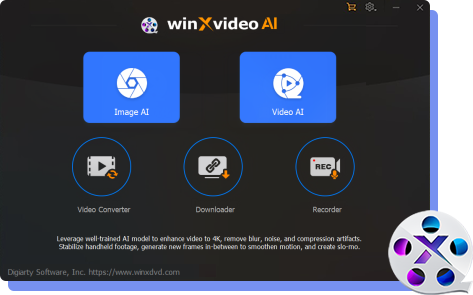
A professional AVI video converter like Winxvideo AI will help you convert AVI to MP4, MOV, WMV, MPEG, FLV, MOV, MP3, etc and vice versa. It is all-in-one video software that can convert multi-track HD videos MKV, TS, H.264/MPEG-4 AVC, SD videos AVI, MPEG, MP4, WMV, MOV, FLV, etc. It is a fast video/audio/DVD converter, a video editor, and compressor with Full Hardware Acceleration.
For PC and Mac only. Go to mobile page.
Video Tutorial: How to Convert AVI to MP4 in Seconds
Related External Source
AVI Knowledge from WikiPedia- Audio Video Interleaved (also Audio Video Interleave), known by its initials AVI, is a multimedia container format introduced by Microsoft in November 1992 as part of its Video for Windows technology...
AVI Knowledge from Afterdawn - Standing for Audio Video Interleave, is a Container format used by Microsoft's Video for Windows multimedia framework...
AVI Knowledge from File-ext - Recent files might be compressed with one or another codecs (compression standard). It can also be seen with QuickTime and RealPlayer (available for the Mac)...